Skip to main content Skip to search Skip to main navigation
Quality products since 1997
Worldwide shipping
Purchase on Account for Authorities
Phone +1 972 588 4362
Loading...
Group of smiling men in vintage suits and ties, gathered closely for a group photograph.

Reading time 120 minutes / Lars Buchwald / 12/05/2025

The Hidden History Behind Every Lock

From Tinkering to Breakthrough: The Forgotten Evolution of Locks

Sometimes it surprises me how little we know about the things that protect us every day. The locks we use seem ordinary. Insert the key, lock or unlock, done. But behind every lock lies a story far more fascinating than anything you might expect in everyday life. People who, centuries ago, tinkered, failed, started again, and in the process laid the foundation for everything we know and use today about locks and keys.

If you look closer, you notice a pattern:

Every invention was an answer to a problem.

Barron’s lever system. Bramah’s attempt to eliminate attacks by making the mechanism more complex. Chubb’s detector, which exposed intruders before they could succeed. Sounds like technology, but in truth these stories tell us about distrust, ingenuity, and the constant race between protection and attack.

And that’s where it gets interesting. Many of these old mechanisms still exist today in modern form. Some weaknesses remain. Others have been solved cleverly. Still others show how creative people become when something absolutely needs to be secure and reliable.

If you want to understand how these historical ideas turned into what we hold in our hands today—or rather, what sits in our doors—then keep reading. The past explains more than you might think. And it shows why our need for security never stops and continually evolves.

Illustration of a historical military leader on a rearing horse, wearing a red cape and gesturing upward.

1778 – 1805

Between 1778 and 1805, the world changed rapidly. Revolutions, upheavals, and new ideas everywhere. And during this exact period, the “new locks” made a major leap forward. For example, in 1778 Robert Barron set the first impulse with his lever system. In 1784 Joseph Bramah followed, developing a mechanism that was meant to virtually eliminate attacks. In 1805, Abraham Stansbury introduced the double-acting pin tumbler system, another significant step toward modern security. While political power struggles raged outside, these inventors worked on something lasting: the attempt to make security more predictable and, above all, more understandable. Anyone looking for the roots of modern locking technology will find them right here.

Robert Barron (1778)

Name: Lever lock
Category: Lever lock
Inventor: Robert Barron from England.
He registered a patent for it in 1778 under the number GB1200, and it is still used today in many door and safe locks. 

Current locks of this type 

Types that descend from Barron’s lever principle today:
• British lever (mortice) locks
• Safe lever locks — they are direct descendants of the lever principle and are still widely used today.
• Simpler door and box locks 

Lockpicking
• Exploiting large manufacturing tolerances or clearly noticeable lever movement (picking).
• Bypass tools to circumvent the mechanical components (picking).
• Direct physical destruction of the mechanism or mounting (destructive entry). 

Risk/Security
Highest risk: Destructive tools + bypass attacks when poorly installed (fast, reliable, universally effective).
Medium risk: Mechanical manipulation / decoding methods when tolerances are large. 

Insights
The greatest vulnerabilities rarely come from manipulation alone, but mostly from physical destruction and weaknesses in installation or hardware.

Joseph Bramah (1784)

Name: Multi-lever lock
Inventor: Joseph Bramah (April 13, 1748 – December 9, 1814) was an English inventor and engineer. In 1784, he invented the so-called Bramah lock.

Current locks of this type 
Types that today descend from the Bramah lever principle:
• Bramah Locks Ltd. (London) – still produces locks almost identical to the original principle.
• Abus Diskus / Abus Granit Plus / Abloy Protec2
• Motorcycle and high-security padlocks (e.g., Kryptonite, Oxford, Trelock) – use wafer or combined disc/slider systems.

Lockpicking
• Destructive tools & levering attacks
• Bypass/removal due to poor installation
• Targeted drilling/milling if no drill protection is present
• Fine manipulation if manufacturing quality is poor (picking)
• Electronic attacks — if electronics are present

Risk/Security
Highest risk: Destructive attacks (hammer, chisel, angle grinder)
Bypass / circumvention (attacks on hardware/frame)
Medium risk: Targeted drilling / milling / pulling / ripping
Low risk: Fine manipulation / decoding

Insights
Even a simple lock can be very resistant when tolerances, hardening, and installation quality are right. The main danger comes from raw force. Radial wafer and disc locks are extremely precise, but vulnerable to physical attacks if they lack drill or lever protection.

Abraham (Abe) Ogier Stansbury (1805)

Name: Double-acting pin tumbler lock
Inventor: Abraham O. Stansbury received a patent in 1807 for a double-acting pin tumbler lock. The pins had to be aligned correctly from both sides at the same time. This created significantly higher resistance to manipulation compared to earlier single-acting pin systems.

Current locks of this type 
Stansbury is therefore considered a pioneer of modern pin-tumbler systems, even if the form we know today was later perfected by Linus Yale Jr. There are no direct Stansbury locks anymore, but the underlying principle lives on in modern variants: Special forms of double-pin chambers Opposing pins or dual-acting tumblers in more complex profiles High-security cylinders combining multiple levels or directions of pin movement

Lockpicking
• Exploiting large manufacturing tolerances — pins were often not perfectly symmetrical. The two active planes could sometimes be influenced one after the other instead of simultaneously.
• Mechanical feedback (e.g., slight give, blocking, friction) to detect which side was already in position, allowing indirect separation of the planes.
• Wear — over time, small gaps formed, sometimes reducing the double requirement to a practically single-action mechanism.

Risk/Security
Highest risk: Destructive attacks (hammer, chisel, angle grinder) and bypass (attacks on hardware/frame)
Medium risk: Targeted drilling / milling / pulling / tearing
Low risk: Fine manipulation

Insights
The double-acting pin tumbler system was a historical breakthrough, but from today’s perspective it is no longer a high-security mechanism. Its greatest protection at the time came from requiring simultaneous alignment of both pin sides — a concept effective against primitive tools, but clearly limited when confronted with modern testing and manipulation techniques.

Painting showing a solitary person from behind, standing on a rock formation and overlooking a misty mountain landscape, holding a cane.

1818 – 1857

Between 1818 and 1857, security was reimagined. Industrialization, technical experimentation, and rapidly growing cities — everything became more complex, including the methods used to attack and bypass locks. In this environment, inventors were overflowing with new ideas. Security needed to improve. In 1818, Jeremiah Chubb introduced his detector lock: a mechanism that not only made manipulation more difficult but also revealed and signaled it. A clever step in a time when tools and knowledge were becoming more widely accessible. 

In 1829, Alexandre Fichet followed with the pump lock — radically different, precise, and far ahead of its time. And in 1857, James Sargent set a milestone in the United States with his combination technology, opening the door to a new era of mechanical security. These years mark the moment when locks stopped merely reacting and began actively monitoring and even controlling. A development that clearly shows how closely technology and societal change are intertwined.

Jeremiah Chubb (1818)

Name: Detector lock (multi-lever lock)
Category:
Inventor: Jeremiah Chubb developed a multi-lever lock with an integrated detector mechanism. The special feature: If someone attempted to manipulate the levers, the lock automatically triggered a “detector state.” At that point, the bolt could no longer be moved — even with the correct key — until the owner reset the lock. This not only made manipulation more difficult, it also made attempts visible.

Current locks of this type 
Chubb’s system is a direct predecessor of modern lever locks / multi-lever systems. Even today, high-quality safe locks still rely partly on this basic principle.

Lockpicking
• Exploiting manufacturing tolerances Early Chubb models occasionally had larger mechanical tolerances: individual levers could react slightly differently. With production variances, it was sometimes possible to detect which plate contacted first. This reduced the intended level of security, because the attack no longer required treating the lever stack as a single unified movement.
• Mechanical feedback Despite the detector, some models offered subtle mechanical cues: slight binding microscopic give friction patterns on the lifting plates
• Wear over years of operation

Risk/Security
Highest risk: Destructive attacks with hammer / chisel / heavy striking tools angle grinders / cutting tools breaking open the lock case
Medium risk: Partially destructive attacks such as drilling the lever stacks (if no carbide barriers are present), milling the case or bolt channel, pulling / tearing when installation is unprotected.
Low risk: fine manipulation

Insights
The Chubb detector lock was one of the strongest anti-manipulation mechanisms of its time. Its key advantage was not only that manipulation became more difficult, but that attempts were automatically detected and made visible. Weaknesses arise mainly from destructive or semi-destructive attacks, far less from fine mechanical manipulation. Wear or tolerances may degrade the system over time, but when new, it was an exceptionally robust lock design.

Alexandre Fichet (1829)

Name: Pump lock
Inventor: Alexandre Fichet developed the pump lock in 1829, a mechanism that differed significantly from the pin and lever locks used until then. The key operated axially rather than rotating: it was inserted like a piston (“pump”) and pushed several radially arranged pins into the correct position simultaneously. This linear operating principle made the lock far more difficult to manipulate intuitively and offered exceptionally high protection for its time.

Current locks of this type 
Modern pump cylinders are still used in France, especially in high-end residential and building security. Today’s versions feature multiple rows of pins, hardened materials, anti-drill protection, coded key profiles, and complex evolutions of the original pump mechanism. Some specialized high-security cylinders also use axial systems based on Fichet’s concept, though massively refined technically.

Lockpicking
• Exploiting manufacturing tolerances Early pump locks sometimes showed: • differences in resistance between individual pins • minimal deviations in axial guides • height variations of individual piston elements. • Mechanical feedback Although the mechanism was intended as an “all-or-nothing system,” some models offered noticeable binding points, different spring tensions, and slight detent sensations during pushing. • Wear over years of operation

Risk/Security
Highest risk: Destructive attacks with hammer / chisel / heavy striking tools angle grinders / cutting tools breaking open the lock case
Medium risk: Partially destructive attacks drilling the axial pin chamber (possible in historical models) milling the front plate or housing areas pulling or ripping out when door mounting is weak
Low risk: Fine manipulation axial probing of individual pins detecting spring tension changes, decoding through wear

Insights
Fichet’s pump lock was a radical break from traditional lock concepts and the first to use an axial, simultaneously reacting multi-pin system. This gave it extraordinary resistance to manipulation and made it a long-standing hallmark of French security engineering. Its weaknesses stem mainly from material quality, manufacturing precision, and aging — less from the core principle. Modern pump locks still follow this concept and remain among the most technically demanding high-security solutions for private and commercial applications.

Linus Yale Sr. (1843)

Name: Combination lock
Inventor: Linus Yale Sr. developed one of the first precise forms of the mechanical combination lock in 1843 — a lock that operated without a key. The mechanism relied on rotating wheels that had to be aligned into an exact position. Only when all wheels reached their correct orientation did their gates form a straight line that allowed the locking bolt to retract. For its time, this was revolutionary because it offered:
- keyless operation
- greater variability
- significantly improved protection against brute-force manipulation. Yale’s invention was a precursor to modern safe combination locks and marked the shift from purely mechanical key systems to intelligent locking technology.

Current locks of this type 
High-quality mechanical safe combination locks are still based on Yale’s principle, though in heavily optimized form. Modern versions feature precision-milled wheels, manipulation-resistant gates, anti-fallback notches, hardened axles, and reinforced housings. Most reputable safe manufacturers (S&G, La Gard, Kaba-Mas, etc.) use concepts directly derived from Yale’s system. The Yale combination lock is not a relic — it is one of the most continuously evolved lock systems in the world.

Lockpicking
• Exploiting manufacturing tolerances Combination locks of that era sometimes suffered from:
- uneven spacing between wheels
- slight differences in wheel thickness
- play in axle guides These tolerances could cause individual wheels to provide feedback earlier than others, making the combination theoretically discoverable. • Mechanical feedback Early wheel locks often produced noticeable cues, such as:
- a small “drop” when reaching the gate position
- slight torque variations
- detectable friction differences between wheels and the fence An experienced attacker could use these signals to narrow down the correct numbers step by step. • Wear in operation Over time, typical aging occurred:
- worn gate edges
- rounded contact points
- increased play in the axle mechanism These signs made accurate gate detection much easier than in a new lock.

Risk/Security
Highest risk: Destructive attacks on the safe body prying or breaking open the safe door cutting tools / angle grinders bypass through attacking the door or frame instead of the mechanism
Medium risk: Targeted partially destructive attacks, such as: drilling the axle or wheel stack (only possible on historical models without carbide blocks) milling at the faceplate removing or tearing out the lock area on weak constructions
Low risk: Fine manipulation step-specific dialing and listening feeling for gate positions decoding through wear or tolerances

Insights
Linus Yale Sr. laid the foundation for all modern safe technology with his combination lock. The mechanism replaced keys with a variable number-wheel system that was both more manipulation-resistant and more flexible. Weaknesses in early models were due mainly to manufacturing tolerances and wear — not the concept itself. Modern versions remain some of the most trusted high-security systems worldwide and still use his core design.

Alfred Charles Hobbs (1851)

Name: Chubb lock
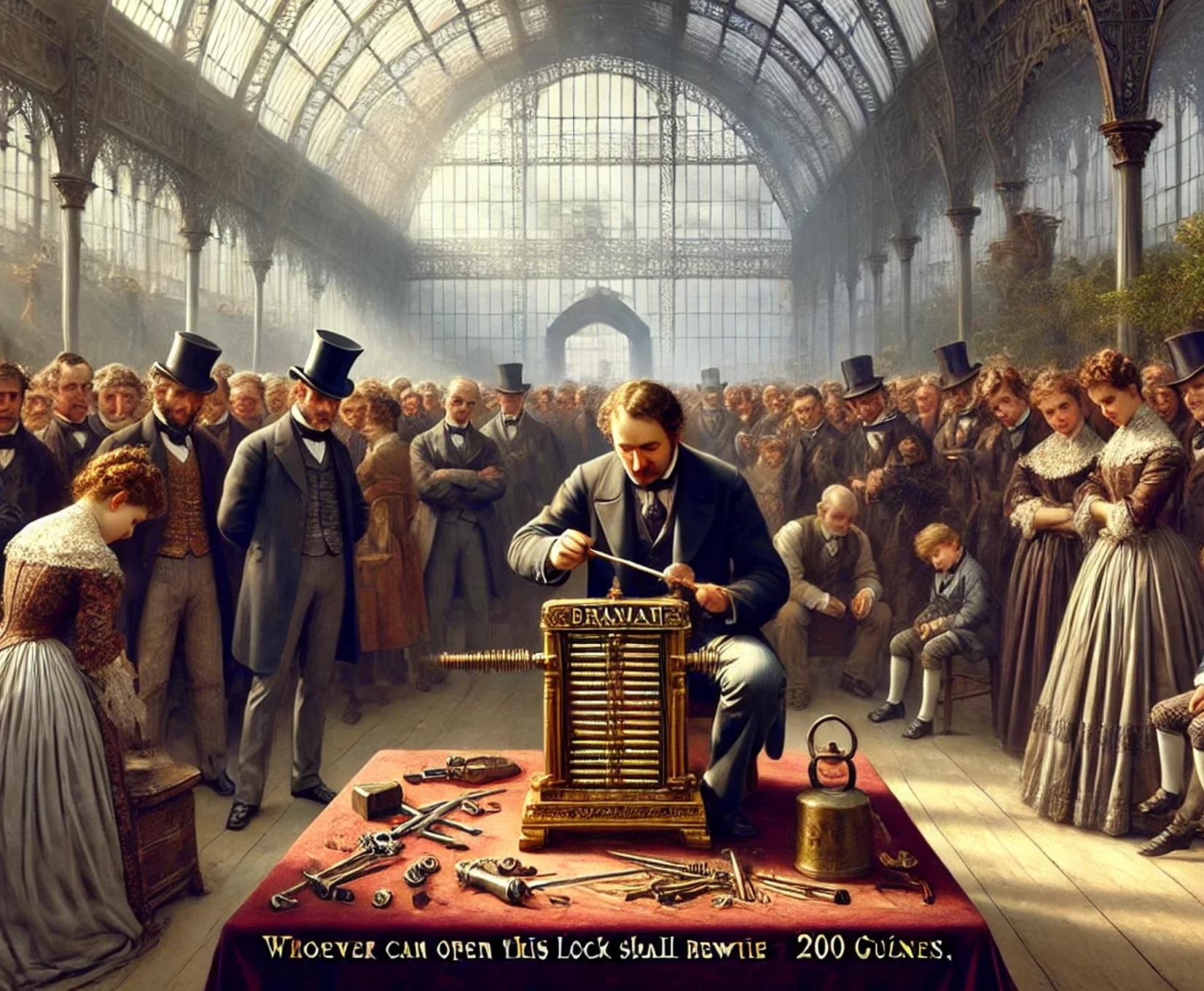
Alfred Charles Hobbs became world-famous at the 1851 Great Exhibition in London when he successfully manipulated the Chubb detector lock — considered “unpickable” for over 30 years. Important to know: Hobbs did not invent a new lock. Instead, he was the first to publicly demonstrate how the complex Chubb mechanism could be bypassed without permanently triggering the detector. His work is considered a milestone because he proved that even the most advanced systems are not unpickable if you understand them deeply. This triggered a new era in security thinking.

Lockpicking
• Exploiting manufacturing tolerances Hobbs noticed that early Chubb locks had:
- slight differences in lever heights
- variations in spring force
- minimal play between the lifting plates and the bolt • Mechanical feedback Despite the detector, the lock provided subtle signals:
- slight movement of individual levers
- binding points just before correct height
- tiny changes in friction These “micro-feedbacks” allowed Hobbs to determine which lever was close to its correct position. By performing extremely controlled movements, he avoided triggering the detector.

Insights
Hobbs proved in 1851 that even the most complex lock systems have weaknesses when manufacturing tolerances, wear, and mechanical feedback converge. His achievement sparked a technological revolution and forced manufacturers worldwide to create more precise, manipulation-resistant designs. The Chubb principle still exists today in modern lever locks — but with much higher security standards that eliminate Hobbs’ historic attack points.

James Sargent (1857)

Name: Changeable combination lock
Inventor: James Sargent developed the first changeable combination lock in 1857. It was a milestone in safe technology because users could change the combination themselves without disassembling the mechanism or replacing the lock. This solved several problems at once:
- stolen or observed combinations could be replaced immediately
- security protocols became more flexible
- safes were far harder to compromise permanently The principle, like Yale’s, used wheel stacks — but with a crucial enhancement: The wheels could be recoded using an internal mechanism. Sargent laid the foundation for all modern professional safe locks.

Current locks of this type 
Modern successors continue to use Sargent’s principle:
- S&G (Sargent & Greenleaf — founded by the inventor)
- LaGard
- Kaba-Mas
- many other safe manufacturers worldwide Changeable mechanical combination locks remain standard in:
- bank safes
- gun safes
- high-security containers
- industrial vaults Today’s versions include:
- manipulation-resistant wheel geometry
- hardened steel components
- anti-drill and anti-mill elements
- precision-manufactured axle systems

Lockpicking
• Exploiting manufacturing tolerances Early Sargent locks sometimes had:
- uneven spacing between wheels
- varying gate depths
- slight play in the axle bushing This allowed a wheel to provide feedback before others were aligned, simplifying combination discovery. • Mechanical feedback Like all early dial locks, Sargent’s models offered:
- a noticeable “drop” when the fence reached the gate
- variations in friction and torque
- brief micro-pauses when passing gate areas • Wear in operation Typical aging effects included:
- worn gates
- rounded edges
- increased play between wheels and axle

Risk/Security
Highest risk: Destructive attacks cutting or breaking the safe body angle grinders, cutting tools, drilling (on the safe body, not the mechanism) attacking door or frame instead of the lock
Medium risk: Targeted partial destruction drilling to the wheel stack or axle (historical models without carbide only) milling or removing material on the front plate tearing out weakly mounted safe areas
Low risk: Fine manipulation listening to the wheel stack detecting gate positions systematic decoding via mechanical feedback exploiting wear or tolerances

Insights
Sargent’s changeable combination lock was one of the most important breakthroughs in safe design. It combined flexibility, manipulation resistance, and practicality in a way that still defines the industry today. Weaknesses historically stemmed from materials, manufacturing precision, and wear — not the core concept. Modern descendants of Sargent’s design remain among the most reliable mechanical security systems worldwide.

Karl Höller (1857)

Name: Pin tumbler lock
Inventor: Karl Höller patented an improved form of the pin tumbler lock in 1857, which differed clearly from earlier, simpler constructions. His mechanism used several stacked pairs of pins (driver and key pins) that needed to be aligned to a precise shear line by a correctly cut key. New in Höller’s design were:
- more precise pin guidance
- improved spring mechanics
- a more compact form factor
- higher repeat accuracy in manufacturing, making it one of the more reliable pin tumbler systems of its time. Höller’s concept was an important transitional step toward later high-precision cylinders — including the later development by Linus Yale Jr. (1861).

Current locks of this type 
Höller’s mechanism is a direct predecessor of modern pin tumbler cylinders. Current successors include:
• round cylinders and profile cylinders worldwide
• modern variants with enhanced security features:
- security pins (spool, mushroom, serrated)
- anti-drill elements
- hardened pins and housing zones
- complex key profiles The Yale cylinder (from 1861 onward) is generally considered a direct evolution of Höller’s principle.

Lockpicking
• Exploiting manufacturing tolerances Höller’s system was also not free from production variance:
- slight pin height differences
- lateral play within pin chambers
- variations in spring tension
- uneven fits between plug and housing These tolerances caused individual pins to provide feedback earlier, enabling selective picking instead of simultaneous lifting. • Mechanical feedback Typical behaviors of early pin systems included:
- binding just before correct height
- small click points while lifting
- torque changes when a pin set correctly A skilled manipulator could detect which pins were already set — making the lock more precise but also mechanically readable.

Risk/Security
Highest risk: Destructive attacks: hammer, chisel, brute force against cylinder or hardware angle grinder or cutting tools bypass attacks on frame/hardware
Medium risk: Targeted partial destruction: drilling pin chambers (easy on historical models without hardened inserts) milling or removing housing material pulling or ripping unprotected cylinders
Low risk: Fine manipulation: selective lifting of individual pins reading torque variations decoding through wear or tolerances

Insights
Karl Höller’s pin tumbler lock was an important milestone in lock engineering. It combined compact design with higher precision and created the foundation for all modern cylinder locks. Its weaknesses — like all systems of the era — stem from tolerances, mechanical feedback, and wear. Even so, Höller’s mechanism was ahead of its time and remains the global standard principle for door lock technology.

Close-up of a patinated bronze statue showing a bearded male figure with arms raised, positioned in front of a stone structure.

1861 – 1878

Between 1861 and 1878, locks were created during a period marked by rapid technological progress. The United States was in the midst of the Civil War, Europe was modernizing its infrastructure, and everywhere people searched for better ways to protect valuables. In 1861, James Sargent introduced his time and combination lock — a mechanism that made security predictable and opened new possibilities for banks. A few years later, in 1865, Linus Yale Jr. refined the pin tumbler lock and set in motion a concept that still sits in millions of doors today. In 1878, Sargent advanced the field once again by introducing improved combination techniques that made manipulation even more difficult. This phase clearly shows how strongly technical development responds to societal pressure. The world demanded reliable systems — and the inventors delivered.

Linus Yale Jr. (1861)

Name: Round cylinder lock with four pin tumblers
Inventor: Linus Yale Jr. developed the round cylinder lock with four pin tumblers in 1861 — a design that later became the foundational model for nearly all modern profile and round cylinders. His construction was based on:
- a cylindrical plug rotating inside a housing,
- four precisely guided pin pairs (key pins and driver pins),
- a specially milled key profile,
- a slim, industrially reproducible form factor.
Yale’s system was smaller, more precise, safer, and more standardized than all previous pin tumbler locks. This made him the “father of the modern cylinder.”

Current locks of this type 
What Yale Jr. invented in 1861 is the primal principle of the modern pin tumbler cylinder. Current representatives include:
- classic profile cylinders in Europe
- round cylinders in the USA, Asia, and many industrial sectors
- security and high-security cylinders from all major manufacturers
- variants with 5, 6, 7 or more pins
- versions with security pins (spool, mushroom, serrated, etc.)
- anti-drill, anti-pull, and anti-snap constructions
 The Yale principle is the global industry standard and the most widespread lock system in the world.

Lockpicking
• Exploiting manufacturing tolerances Even early Yale cylinders had natural production variances:
- minimal height differences between the four pins,
- lateral play between plug and housing,
- differences in spring tension,
- uneven friction inside pin chambers. These tolerances caused the pin pairs to set not simultaneously but sequentially — an effect that fundamentally enables selective manipulation.
• Mechanical feedback The Yale cylinder is famous for providing clear feedback, especially in early designs:
- noticeable “setting” of pins when reaching the shear line,
- slight rotation (plug movement) after each correctly set pin,
- torque changes depending on where friction occurs in the cylinder. This made the mechanism precise but also mechanically readable.
• Wear over time With continued use, the following occurred:
- worn pin chambers,
- weakened springs,
- worn pin tips,
- increased plug play. These signs made the cylinder easier to interpret, as mechanical feedback became more pronounced.

Risk/Security
Highest risk: Destructive attacks:
hammer, chisel, brute force against hardware
angle grinders / cutting tools
attacks on the door frame as bypass

Medium risk: Targeted partial destruction:
drilling the pin chambers in historical cylinders (easily done without hardened inserts)
milling or removing housing material
pulling / ripping out unprotected round cylinders

Low risk: Fine manipulation:
selective pin lifting
reading torque and set points
decoding through wear and mechanical play

Insights
Linus Yale Jr. created the foundation of modern lock engineering with his round cylinder design. His four-pin system was precise, easy to manufacture, reliable, and extremely compact — becoming the mechanical standard still used worldwide today. Its weaknesses lie mainly in manufacturing tolerances, mechanical feedback, and natural wear, not in the concept itself. Modern advancements have largely eliminated these vulnerabilities, while the core principle has remained strong and unchanged.

James Sargent (1873)

Bezeichnung: Zeitschloss
Erfinder: James Sargent entwickelte eines der ersten mechanischen Zeitschlösser, ein Sicherheitssystem, das einen Tresor nur innerhalb eines definierten Zeitfensters öffnen ließ – unabhängig davon, ob Schlüssel, Kombination oder Zugangscode bekannt waren. Der Kern seiner Idee: - ein präziser, federgetriebener Uhrmechanismus, - gekoppelt mit einer Sperreinrichtung, die den Riegel erst freigibt, wenn die voreingestellte Zeit verstrichen ist, - mehrere Zeitschaltwerke (oft 2–3), um Redundanz zu schaffen. Ziel war: Raubüberfälle, Komplizenfälle und erzwungene Öffnungen zu verhindern – selbst dann, wenn ein Räuber den Tresorwärter bedrohte. Sargents Zeitschloss wurde internationaler Standard für Banken, Geldtransporte und Hochsicherheitsbereiche.

Aktuelle Schlösser dieses Typs 
Zeitschlösser sind bis heute Standard bei:
- Banktresoren
- Geldautomaten
- Werttransportfahrzeugen
- Hochsicherheitstresoren
- Cash-Management-Systemen 

Moderne Varianten kombinieren oft: 
- digitale Programmierung,
- redundante Uhrwerke,
- manipulationssichere Gehäuse,
- automatische Sperrprotokolle,
- Eintrittsverzögerung (Time Delay).
Viele Hersteller (z. B. S&G, Kaba-Mas, Lagard) produzieren weiterhin mechanische und elektronische Zeitschlösser, die Sargents Grundprinzip nahezu unverändert aufgreifen.

Lockpicking
Ausnutzung von Fertigungstoleranzen Frühe Zeitschlösser hatten gelegentlich:
- ungleichmäßige Ganggenauigkeit der Uhrwerke
- Toleranzen in den Kupplungsmechanismen
- leichte Variationen der Rückstellfedern
In seltenen Fällen konnte der Mechanismus „stehen bleiben“ oder hörbare Unterschiede produzieren, die Rückschlüsse auf die verbleibende Zeit gaben – allerdings ohne die eigentliche Sperre zu überwinden. Wichtig: Toleranzen halfen nicht beim Manipulieren – sie führten höchstens zu Fehlfunktionen.
• Mechanisches Feedback Ein echtes Zeitschloss gibt praktisch kein nutzbares Feedback:
- kein Drehmoment
- keine Rastpunkte
- keine mechanisch interpretierbaren Rücksignale Die Uhr läuft, egal was der Angreifer tut. Man hört nur das Ticken – und das gibt keinerlei Information über die Sperrposition. Höchstens beim Hineinhören konnten Fachleute damals Unterschiede im Geräuschverhalten feststellen, die auf Wartungszustände oder Defekte hindeuteten – aber nicht auf eine Möglichkeit, das Schloss zu manipulieren.
• Abnutzung im Betrieb Alterung erzeugte typische Effekte:
- Gangungenauigkeit
- stärkeres oder schwächeres Ticken
- erhöhte Reibung in alten Uhrwerken
Diese Effekte machten das Zeitschloss unzuverlässiger, aber nicht angreifbarer. Im Gegenteil: Ein verschlissenes Zeitschloss schloss oft strenger als ein neues.

Risiko/Sicherheit
Höchstes Risiko: Zerstörende Angriffe: Aufbrechen des Tresorgehäuses Trennwerkzeuge, Brennschneider, Bohrer Angriff auf Rahmen/Beschlag statt auf den Mechanismus → Das Zeitschloss selbst ist extrem robust – der umgebende Tresor ist der realistischere Schwachpunkt.
Mittleres Risiko: Gezielte teilzerstörende Angriffe: Bohren bis zum Zeitschloss (bei alten Modellen theoretisch möglich, aber extrem schwierig) Fräsen des Schlosskastens Herauslösen der Zeitschlossplatte bei schlechter Befestigung
Geringes Risiko: Feinmanipulation: klassisches Manipulieren ist praktisch unmöglich Uhrwerk läuft unabhängig vom Angreifer kein nutzbares Feedback keine Stift- oder Scheibenmechanik

Erkenntnisse
James Sargent schuf mit seinem Zeitschloss ein System, das nicht nur den Zugriff reguliert, sondern ihn im entscheidenden Moment unmöglich macht. Es war kein Anti-Manipulations-Schloss im klassischen Sinne – es war ein Anti-Zugriff-Schloss, das Gewalt über Zeit stellte. Seine Schwachstellen liegen nicht im Konzept, sondern in: Uhrwerkstoleranzen, Wartungsbedarf, und dem Tresorumfeld. Bis heute gilt Sargents Zeitschloss als eine der zuverlässigsten und wirkungsstärksten Erfindungen der physischen Sicherheitstechnik.

Theodor Kromer (1874)

Bezeichnung: Protector-Schloss
Erfinder: Theodor Kromer präsentierte 1874 das Protector-Schloss, ein hochkomplexes Hebelwerk-System, das speziell für Tresore und Sicherheitsbehälter geschaffen wurde. Sein Prinzip basierte auf: mehreren hochpräzisen Hebelzuhaltungen (oft 6–12 Stück), einer aufwendig konstruierten Schlüsselkontur, die jeden Hebel in eine exakt definierte Höhe brachte, einer mehrfach gestuften Gate-Geometrie, die Manipulationsversuche deutlich erschwerte, äußerst engen Fertigungstoleranzen, die die Hebel nur dann freigaben, wenn alle exakt ausgerichtet waren. Kromers Protector war eines der ersten Hebelschlösser, das industriell zuverlässig gefertigt werden konnte und dennoch einen ungewöhnlich hohen Manipulationswiderstand bot. Es wurde schnell zu einem Standard im Tresorbau – insbesondere im deutschsprachigen Raum.

Aktuelle Schlösser dieses Typs 
Aktuelle Vertreter:
- Kromer Protector 3/4 (moderne Versionen, teilweise mit Zusatzsicherungen)
- moderne Hebel-Tresorschlösser mehrerer Hersteller, die auf dem Kromer-Grundlayout basieren
- Varianten mit gehärteten Boxen manipulaitonssicheren Hebelgeometrien und zusätzlichen Sperrelementen.
Der originale 1874er Mechanismus wird heute nicht mehr gebaut, aber seine Konstruktionsphilosophie lebt fort: präzise Hebeltechnik, eng tolerierte Gates, hohe Manipulationsresistenz. Besonders in DACH-Ländern gelten Kromer-Schlösser bis heute als ein Synonym für zuverlässige, robuste Tresortechnik.

Lockpicking
• Ausnutzung von Fertigungstoleranzen Frühe Protector-Modelle hatten trotz hoher Qualität gewisse Streuungen:
- leichte Unterschiede in Hebelhöhen
- mikroskopisches Spiel in der Führung der Hebel
- minimale Varianz in Federhärte oder Gate-Tiefe
Diese Effekte konnten dazu führen, dass einzelne Hebel etwas früher oder definierter Feedback gaben als andere – ein möglicher Ansatzpunkt für geübte Manipulatoren.
• Mechanisches Feedback Trotz des komplexen Hebelsystems konnten einzelne Rückmeldungen wahrnehmbar sein:
- leichtes Einrasten beim Erreichen des Gates
- fein dosierbare Unterschiede im Drehmoment
- kleine Bewegungsänderungen beim Aufliegen der Hebel Gegenüber einfachen Mehrzuhaltungsschlössern war das Feedback sehr subtil, aber ein erfahrener Spezialist konnte einzelne Signale interpretieren, insbesondere bei älteren, nicht perfekt gewarteten Modellen.
• Abnutzung im Betrieb Mit den Jahren traten typische Alterungseffekte auf:
- abgeflachte Hebelkanten
- eingelaufene Gate-Flächen
- weichere Rückzugsfedern leicht erweitertes Spiel im Riegelmechanismus.
Diese Abnutzung erhöhte die mechanische Lesbarkeit des Schlosses und konnte die ursprüngliche Sicherheit graduell senken, vor allem, wenn das Schloss nur selten gewartet wurde.

Risiko/Sicherheit
Höchstes Risiko: Zerstörende Angriffe: Brechwerkzeuge (Hammer, Meißel, Vorschlagwerkzeuge) Winkelschleifer / Trenntechnik Aufbrechen des Tresorkörpers statt des Schlosses Angriff auf Rahmen, Tür oder Bolzen Einschätzung: Das Protector-Schloss selbst ist extrem robust. Die größte reale Schwachstelle bleibt das Tresorumfeld, nicht der Mechanismus.
Mittleres Risiko: Gezielte teilzerstörende Eingriffe: Bohren des Hebelschlosskastens (bei historischen Modellen ohne Hartmetall möglich) Fräsen einzelner Hebelkammertiefen Ziehen oder Herauslösen bei schlechter Tresorkonstruktion Einschätzung: Historische Modelle waren stabil, aber nicht gegen moderne Hartmetallbohrer geschützt. Moderne Protector-Versionen besitzen dagegen massive Anti-Bohr-Elemente.
Geringes Risiko: Feinmanipulation: Tasten einzelner Hebel über leichtes Drehmoment interpretieren minimaler Rastpunkte Decodieren über Hebelverschleiß oder Toleranzen Einschätzung: Das Protector-Schloss gehört historisch zu den am schwersten manipulierbaren Hebelschlössern. Feinmanipulation bleibt daher die schwächste realistische Angriffsform, selbst bei älteren Modellen.

Erkenntnisse
Theodor Kromers Protector-Schloss war eines der präzisesten, manipulationsresistentesten Hebelmechanismen seiner Zeit und gilt bis heute als ein Meilenstein im Tresorbau. Seine Stärken liegen in der engen Toleranzführung, der komplexen Hebelgeometrie und der hohen Fertigungsqualität. Schwachstellen entstehen historisch vor allem durch Abnutzung oder gegen zerstörende Methoden – nicht durch Manipulation. Moderne Varianten des Protector-Systems gehören weiterhin zu den zuverlässigsten Hebelschlössern im professionellen Sicherheitsumfeld.

Joseph Loch (1878)

Bezeichnung: Zahlenschloss
Erfinder: Joseph Loch entwickelte 1878 ein fortschrittliches mechanisches Zahlenschloss, das als eine der stärkeren Weiterentwicklungen der bis dahin bekannten Kombinationsmechanismen gilt. Sein Konzept nutzte: mehrere präzise gelagerte Zahlen- bzw. Kombinationsscheiben, eine robuste, manipulationserschwerte Gate-Geometrie, verbesserte Kopplungsmechanismen zwischen den Scheiben, ein zuverlässiges Freigabesystem für den Riegel. Lochs Ziel war, die Schwächen früher Scheibenzahlenschlösser zu reduzieren, insbesondere die manipulationsanfälligen Rückmeldungen beim Erreichen des Gates. Sein Mechanismus erreichte eine bessere Gleichmäßigkeit der Rückmeldung und galt damals als einer der sichersten Code-Schlösser im Tresorbau.

Aktuelle Schlösser dieses Typs 
Lochs Prinzip wurde zu einem der grundlegenden Mechanismen moderner Tresorzahlen­schlösser. Heute basieren viele Systeme auf seinem Aufbau:
- mechanische Tresor-Kombinationsschlösser (S&G, LaGard, Kaba-Mas)
- Zahlenschlösser an Wertschutzschränken und Waffenschränken
- sichere mechanische Schließwerke für Banktresore
Moderne Nachfolger besitzen:
- präzisionsgefertigte Scheiben
- manipulationsgeschützte Gates
- gehärtete Achsen
- Anti-Bohr-Platten
- verbesserte Kopplungssysteme

Lockpicking
• Ausnutzung von Fertigungstoleranzen Selbst bei Lochs verbesserter Konstruktion gab es Produktionsschwankungen:
- minimale Höhen- oder Tiefenabweichungen an den Gates
- leicht unterschiedliche Abstände zwischen den Scheiben
- geringfügiges Spiel in der Achsführung
- Varianzen in der Kopplungsmechanik
Diese Punkte konnten dazu führen, dass eine Scheibe etwas klareres Feedback lieferte als die anderen – ein möglicher Ansatzpunkt bei gezielter Manipulation.
• Mechanisches Feedback Während Lochs Design das Feedback bereits reduzierte, blieben bei frühen Modellen dennoch spürbare Signale:
- kleines Einfallen des Hebels in das richtige Gate
- verändertes Drehgefühl beim Erreichen der korrekten Position
- minimales „Hängenbleiben“ beim Übergang über den Gate-Schlitz
Für ungeübte Personen war das kaum wahrnehmbar, aber professionelle Manipulatoren konnten diese Rückmeldungen nutzen, um die Kombination einzukreisen.
• Abnutzung im Betrieb Durch häufige Nutzung veränderte sich das mechanische Verhalten:
- abgeschliffene Gate-Kanten
- eingelaufene Kontaktflächen
- weicher werdende Scheibenfederung
- zunehmendes Achsspiel
Diese Abnutzung machte das Schloss mechanisch deutlicher lesbar und senkte die Manipulationsfestigkeit über die Jahre hinweg.

Risiko/Sicherheit
Höchstes Risiko: Zerstörende Angriffe: Öffnen des Tresors durch massive Gewalt (Hammer, Meißel, Vorschlagwerkzeuge) Einsatz von Winkelschleifer, Brennschneider oder Trenntechnik Angriffe auf Rahmen oder Wandung statt auf das Schloss
Mittleres Risiko: Gezielte teilzerstörende Angriffe: Bohren bis zum Scheibenstapel (historisch möglich, wenn keine Hartmetallplatten vorhanden waren) Fräsen der Schlossfront Heraushebeln oder Ausfräsen bei alten Tresorbauarten
Geringes Risiko: Feinmanipulation: Abhören des Gate-Einrastverhaltens Detektieren von Rastpunkten oder Reibungsmustern Decodieren durch Toleranzen oder Abnutzungsanalyse

Erkenntnisse
Joseph Lochs Zahlenschloss war ein wichtiger Schritt in der Entwicklung von manipulationsgeschützten Tresormechanismen. Es reduzierte mechanisches Feedback, verbesserte die Fertigungstoleranzen und erhöhte die Robustheit des Kombinationsmechanismus. Seine Schwächen lagen weniger im Konzept als im Material und der damaligen Fertigungspräzision. Heute bildet Lochs Grundidee einen festen Bestandteil vieler hochwertiger Tresorsysteme weltweit.

Vintage industrial workshop with multiple workers operating heavy machinery during a manufacturing process.

1907 – 1934

Between 1907 and 1934, the world changed at breathtaking speed. Electricity became part of everyday life, cars appeared in the streets, and with this new mobility came a growing need for reliable security. In 1907, Samuel Segal introduced the first modern padlock with a protected shackle — an idea that spread quickly because it made simple attacks far more difficult. From the 1920s onward, development accelerated further. Companies like Yale and Sargent used improved manufacturing techniques to build locks that were more precise and more durable. In 1934, another important step followed: new cylinder concepts that could withstand brute force and manipulation much better than earlier designs. These years clearly show how closely technological progress and security needs are connected. The faster everyday life changed, the more important it became to have a lock that remained reliable.

Emil Henriksson (1907)

Name: Disc detainer / disc tumbler lock
Inventor: Emil Henriksson invented the disc detainer (or disc tumbler) lock in 1907 — a completely different functional principle compared to traditional pin or lever locks. His design was based on: several rotatable discs, a specially shaped key (“beard”) that turned each disc to a defined angular position, a gate alignment that had to form a continuous channel across all discs, a blocking element (typically a lever or bolt) that could only retract when this channel was aligned. The major difference: This lock works entirely through rotation, not linear movement. As a result, it provided exceptionally high resistance to all classical manipulation methods of its time. Henriksson’s system is considered the predecessor of modern high-security disc-detainer locks and was later further developed by several manufacturers.

Current locks of this type 
- modern disc-detainer locks used in safes and specialized security applications
- high-precision disc cylinders from certain European manufacturers
- variants with improved disc design, hardened materials, and anti-manipulation profiles
Some niche high-security systems continue to use disc or plate detainer mechanisms because they are:
- resistant to traditional pin manipulation
- highly precise in coding
- difficult to reproduce or decode
Henriksson’s concept has therefore not disappeared — it lives on as a specialist high-security solution.

Lockpicking
• Exploiting manufacturing tolerances Even disc-detainer locks of that era had certain variances:
- slight manufacturing inconsistencies in disc angles
- small amounts of play in disc bushings
- minimally varying gate depths or widths
- differences in key engagement points Such tolerances could result in individual discs providing feedback earlier when a tool or false key approached the correct gate position.
• Mechanical feedback Despite the complex disc mechanics, some feedback could still be detected:
- a perceptible “click” when a disc reached its gate
- slight torque fluctuations
- changes in friction when sliding over a gate The feedback was far more subtle than in pin tumbler locks but still interpretable by trained specialists.
• Wear over time With use, typical wear occurred:
- worn disc seats
- beveled gate edges
- increased lateral play in the rotational axis
- uneven friction from aging materials This wear reduced the original precision and made the mechanism increasingly readable.

Risk/Security
Highest risk: Destructive attacks:
brute-force attacks on the safe door or hardware
angle grinders, chisels, cutting tools
attacking the door frame or housing rather than the mechanism

Medium risk: Targeted partial destruction:
drilling the lock chamber (possible on early models without carbide inserts)
milling individual disc channels
removing the lock case in older safes

Low risk: Fine manipulation:
rotating individual discs with finely controlled torque
feeling for gate positions
decoding through wear or tolerances

Insights
Emil Henriksson’s disc-detainer / disc tumbler lock was a radical break from previous lock technologies and remains one of the most innovative mechanisms of the early 20th century. Through its rotating principle, multi-disc architecture, and tight tolerance guidance, it created a system far more resistant to manipulation than classic pin or lever designs. Its weaknesses lie mainly in manufacturing tolerances, wear, and destructive attacks — not in the principle itself. Modern descendants of Henriksson’s design are still among the most robust safe locks available in specialized high-security applications.

Walter Reinhold Schlage (1909)

Name: Door lock with two buttons for light control
Inventor: Walter Reinhold Schlage – later founder of the globally known brand Schlage – developed in 1909 an unusual and technically innovative door lock with integrated electric light control. The design combined:
- a classic door lock mechanism
- two push buttons on the inside
- an integrated electrical contact mechanism
- the ability to switch the light on and off when entering or leaving a room without needing a separate wall switch.
The idea was ahead of its time: Schlage combined mechanical security with the then-modern electrification of buildings. This lock is considered one of the earliest examples of electromechanical building technology, decades before “smart locks” became a topic.

Current locks of this type 
The exact system Schlage created in 1909 is no longer produced, but its principle lives on in modern form: Current representatives can be found, among others, in: electromechanical door locks, hotel card locks, push-button mortise locks, access solutions with integrated control functions, smart home door locks with light and building control. Schlage as a brand (still a major player in the US market) later produced cylinder locks, lever sets, and electromechanical systems that directly evolved the core principle: a lock that does more than just lock.

Lockpicking
• Exploiting manufacturing tolerances Even Schlage’s early electromechanical locks had natural production variances:
- slightly different switching travel of the contacts
- varying spring force in the push buttons
- minimal variations in the mechanical couplings between latch/bolt and switching mechanism. These tolerances could help cause malfunctions on the electrical side, but not bypass the lock mechanism itself.
• Mechanical feedback The mechanical bolt section was relatively simple and provided:
- noticeable detents when opening
- slight binding or give in the bolt mechanism
- audible noises from the contact switching
For attackers, however, these signals offered no real manipulation advantage, as the core lock mechanism was comparatively simple and robust.
• Wear in operation Over time, typical aging effects appeared:
- worn button springs
- reduced switching precision of the light contacts
- wear in the bolt mechanism
- contact corrosion due to early electrical materials.
This wear impaired the function of the light control, but not the mechanical security of the lock itself. Important: The security effect of a normal door lock was not weakened by the electrical add-on function.

Risk/Security
Highest risk: Destructive attacks: hammer, chisel, brute force against the hardware use of angle grinder / cutting tools attacks on the door frame / surrounding structure as bypass
Medium risk: Targeted partial destruction: drilling the lock case (historically quite easy), milling the bolt pocket or hardware, pulling out weakly mounted lock cases
Low risk: Fine manipulation: probing the bolt mechanism manipulation via small tolerances or wear slight torque changes when moving the bolt

Insights
Walter Reinhold Schlage was one of the first to combine traditional locking technology with electrical auxiliary functions. His door lock with light control was an early form of building system integration – a precursor of what we now call “smart home”. The lock itself provided the mechanical security of its time, while the electrical component increased convenience without creating a relevant security weakness. Schlage’s invention clearly shows how early electromechanics were integrated into everyday applications and how strongly this influenced later generations of locks.

John Junkunc (1910)

Name: Single-dial combination lock
Inventor: John Junkunc developed around 1910 a combination lock with only a single dial which, unlike earlier multi-part or multi-dial concepts, offered a much simpler operation. The core of his design: a central, rotating single dial, a stack of several internal combination wheels behind it, a precise coupling mechanism that controls the internal wheel stack via the single dial, a fence or lever that is only released when all gates are perfectly aligned. The advantage of the system: much simpler operation, faster entry of the combination, and a more compact mechanism without sacrificing the security logic of traditional combination locks. Junkunc’s approach later became especially popular for compact safes, cash boxes, and industrial security containers.

Current locks of this type 
Current representatives include:
- compact combination locks on small safes
- portable safes
- cash and security cases
- some consumer models (e.g., common fire safes)
- simplified safe locks with only one operating dial
Modern systems use:
- precision-machined wheels
- hardened axles
- manipulation-resistant gate geometry
- anti-drill and anti-mill plates
- friction-optimized coupling mechanisms
The single-dial operating logic introduced by Junkunc is today standard in many small mechanical combination locks.

Lockpicking
• Exploiting manufacturing tolerances Junkunc’s systems were also subject to the production limits of their time:
- slightly varying wheel spacing
- uneven axial tolerances
- differences in gate depth and width
- play in the coupling between dial and wheel stack
These tolerances could cause individual wheels to give clearer feedback than others – a factor professional manipulators could exploit.
• Mechanical feedback Like most wheel-based mechanisms, Junkunc’s lock showed:
- a noticeable drop of the fence when reaching the gate
- perceptible friction changes while dialing
- slight “catching” when passing a gate
- changing torque when the wheel pack was differently loaded
The single dial made the system more convenient, but mechanically it could also transmit manipulation signals.
• Wear in operation Over time, typical wear patterns appeared:
- worn gate surfaces
- weakening springs on the fence
- increased axial play of the wheels
- worn contact points between dial and coupling mechanism
This wear made the lock more acoustically and mechanically readable, reducing the manipulation resistance of older models.

Risk/Security
Highest risk: Destructive attacks: forcing open the safe door or deforming the housing angle grinders, cutting torches, heavy striking tools bypass via door frame instead of attacking the lock itself
Medium risk: Targeted partial destruction: drilling to the wheel stack (possible on historical models), milling the faceplate or opening the lock housing, pulling out poorly mounted lock plates.
Low risk: Fine manipulation: listening for the gate drop, feeling friction changes via the dial, decoding through wear or tolerances.

Insights
With his single-dial combination lock, John Junkunc created a system that successfully combined user comfort and security. His mechanism made combination entry more intuitive and enabled more compact lock designs without weakening the underlying safe mechanics. Its weaknesses – as with most wheel locks – lie in tolerances and wear, not in the concept itself. His principle is still used today and forms the basis of many compact mechanical combination locks in both private and industrial applications.

Johann Schweiger (1912)

Name: Pass-through key lock
Inventor: Johann Schweiger patented the so-called pass-through key lock in 1912 — a system in which the key is inserted from one side through the entire lock and directly actuates the tumblers on both sides. What made Schweiger’s design special: the key passes completely through the lock, it acts simultaneously on tumblers or sliders on both sides, the entire locking action is triggered by a linear push movement rather than rotation, the mechanism allows very compact lock bodies with reduced complexity. This system was intended mainly for interior doors, furniture, and light protection applications rather than high-security environments. Its strength lay in easy operation and quick, cost-efficient production.

Current locks of this type 
Modern representatives can be found in:
- furniture and cabinet locks
- simple box locks
- interior doors in nostalgic or retro designs
- simple metal cabinets and lockers
- toolboxes and light suitcase locks
Modern pass-through systems are technically refined but fundamentally still:
- straightforward
- inexpensive to manufacture
- designed for everyday doors or furniture
- not intended for high manipulation resistance
The basic idea of the pass-through mechanism is still in use today – but not in the high-security sector.

Lockpicking
• Exploiting manufacturing tolerances Early pass-through lock models had typical deviations:
- different height positions of the tumblers
- play in the guide paths of the pass-through mechanism
- small variations in slider or tumbler positioning
- uneven spring force
These tolerances could cause individual tumblers to react earlier or more distinctly, creating mechanical readability.
• Mechanical feedback Despite its simple construction, there was noticeable feedback:
- slight binding of sliders before reaching the end position
- a perceptible drop of the tumblers when the correct position was reached
- differing friction points while pushing the key through
A skilled manipulator could use these signals to test the mechanism step by step.
• Wear in operation Regular use led to typical signs of wear:
- worn guide paths
- rounded slider edges
- weakening springs
- increased play in the pass-through channel
This aging made the mechanism much more audible and tangible, making manipulation approaches easier.

Risk/Security
Highest risk: Destructive attacks: brute force (hammer, chisel, breaking the lock case), prying or punching through thin hardware, attacking the door or frame instead of the lock itself.
Medium risk: Targeted partial destruction: drilling in the slider or tumbler area, milling the lock case, pulling out or prying off the lock with weak mounting.
Low risk: Fine manipulation: probing the sliders through the keyway, detecting detent points via tool movement, decoding through wear and tolerances.

Insights
Johann Schweiger’s pass-through key lock was a functional and production-friendly solution for everyday applications. It relied on linear operation instead of rotation and offered a simple design that spread quickly — but without serious security ambitions. Its weaknesses naturally lie in manufacturing tolerances, mechanical feedback, and wear. Today, the system is still used, but mainly in furniture and interior applications, not in high-security contexts.

Samuel Segal (1912)

Name: Jimmy-proof lock
Inventor: Samuel Segal – himself a New York police officer – invented the jimmy-proof lock in 1912, a new type of door lock developed specifically against the standard break-in method of the time: “jimmying”, i.e., prying the door open with crowbars or wedges. His system was based on: two vertically moving locking bolts, a swinging or rotating mechanism that blocks both bolts simultaneously, a strong surface-mounted interior installation that functions independently of the door frame, a design that prevents the door and frame from being pried apart. The jimmy-proof lock was one of the first systems specifically engineered against prying attacks and thus created an entirely new category of door security.

Current locks of this type 
This lock is still used millions of times today. Modern jimmy-proof locks are still common, particularly in the USA and Asia, typically on:
- rental apartments
- wooden doors in older buildings
- multi-family homes
- apartments and brownstones in big cities
The reason: They can be mounted on the interior without weakening the door structure itself. Current models feature: hardened bolts, improved swing bars, anti-drill plates, better mounting systems, modern cylinder interfaces (Euro or rim cylinders). This makes the jimmy-proof lock still a widespread and reliable retrofit solution for door security today.

Lockpicking
• Exploiting manufacturing tolerances Even early jimmy-proof models had certain tolerance issues:
- slightly different vertical positions of the double bolts
- play in the swing-bar mechanism
- inconsistent fit between bolts and strike box
- varying bolt travel distances
If these tolerances were too large, an attacker could in rare cases apply excessive pressure to the door leaf so that the bolt mechanism gave way slightly.
• Mechanical feedback Since the lock is mounted on the inside, manipulable feedback is very limited. Early models could still offer minor indications:
- slight play in the swing mechanism
- noticeable detents in the turning mechanism
- audible contact noises in thinner housings
However, this information is hardly sufficient for real fine manipulation, because the mechanism, unlike pin or wheel locks, does not work sequentially.
• Wear in operation With regular use, typical wear patterns developed:
- worn swing bars
- beveled bolt edges
- slight play in mounting screws
- increased play in the mechanism
This wear could make the lock somewhat more vulnerable to strong prying forces, but not to manipulation attempts.

Risk/Security
Highest risk: Destructive attacks: brute-force breaking of the door itself (not the lock), violent prying on door leaf or frame, use of crowbars, wedges, striking tools, attacks on weak door structures.
Medium risk: Targeted partial destruction: drilling the cylinder (not the lock body), removing or ripping off the faceplate with poor mounting, milling the cylinder interface.
Low risk: Fine manipulation: probing the installed cylinder (only if the cylinder itself is manipulable), decoding the cylinder via wear or tolerances, slight use of play in the swing mechanism.

Insights
Samuel Segal’s jimmy-proof lock was a milestone in practical door security. It directly addressed the most commonly exploited weakness of its time: prying. Instead of focusing on protecting the cylinder or mechanism, the system reinforced the door structure as a whole – a revolutionary concept at the time. Its weaknesses lie: - primarily in the door and frame materials - secondarily in the installed cylinder - hardly in the mechanism itself To this day, the jimmy-proof lock remains one of the most effective retrofit systems against prying attacks on standard doors.

Harry Soref (1924)

Name: Padlock
Inventor: Harry Soref founded the Master Lock Company in 1924 and developed a new type of particularly robust padlock that permanently changed the market. His key contribution was: a laminated lock body made of stacked and riveted steel plates, an extremely strong shackle made of hardened steel, a cost-effective yet resilient manufacturing process, a compact design that was more resistant to many common attacks of the time. Soref wanted to create a padlock that was both affordable and secure — and he succeeded. The laminated padlock became a worldwide standard in industry, transport, and private use.

Current locks of this type 
Soref’s basic concept is a global standard. Current representatives include:
- classic laminated padlocks for industrial and home use
- weather-resistant outdoor variants
- padlocks with pin tumbler or disc detainer mechanisms
- high-security shackles made of boron steel or hardened carbon steel
- combination lock versions based on the laminated body
Master Lock still produces modernized versions of Soref’s original design today. Numerous manufacturers around the world have adopted the principle. Soref’s concept is one of the most enduring designs in lock engineering history.

Lockpicking
• Exploiting manufacturing tolerances Early models sometimes had:
- lateral play in the shackle
- slightly inconsistent lamination quality
- uneven fit of the core mechanism
- tolerances in the pin chambers (for pin cylinder versions)
This could make the mechanism more mechanically readable, especially in aging locks.
• Mechanical feedback Depending on the model (bolt-based or pin cylinder), there was noticeable feedback:
- slight pin “setting” in cylinder variants
- perceptible shackle binding just before opening
- audible feedback from internal bolts
These signals could be used to analyze the mechanism, though mainly in locks with simple cylinders.
• Wear in operation Weather and use led to typical problems:
- rust in the laminations (especially in unplated steel versions)
- worn shackle guides
- pin wear in the cylinder
- corroded springs or bolts
This wear made some padlocks much easier to manipulate, and very old models sometimes even failed under “tapping” or shackle pressure.

Risk/Security
Highest risk: Destructive attacks: bolt cutters / cutting tools angle grinders / cutoff wheels hammer and chisel attacks levering and breaking the shackle
Medium risk: Targeted partial destruction: drilling the cylinder (if there is no anti-drill protection) milling the lock body at thin points pushing or pulling out the shackle where fit is poor prying when poorly mounted
Low risk: Fine manipulation: probing the pin cylinder (if present) decoding simple combination versions exploiting mechanical feedback in worn mechanisms

Insights
In 1924, Harry Soref revolutionized the padlock with a laminated steel body that was robust, inexpensive, and suitable for mass production. His concept remains one of the most widely used standards worldwide and is a prime example of how industrial manufacturability and security can be combined. Traditional weak points lie in the shackle and in simple cylinder designs, not in the robust laminated construction. Modern versions still rely on Soref’s basic idea and remain a fixed component of global security technology.

Sylvester Wöhrle (1924)

Name: Cylinder lock with Hahn profile
Inventor: Sylvester Wöhrle registered in 1924 a new cylinder lock system with a Hahn profile, an advanced mid-profile for its time designed to improve the security and flexibility of cylinder locks. The so-called “Hahn profile” was characterized by: a profile-guided keyway that could not easily be copied, additional lateral guiding contours, a more complex key geometry than common round or flat keys, a cylinder form that made manipulation with simple tools more difficult. Wöhrle wanted to create a system that still relied on classic pin tumblers but added extra mechanical barriers through a distinctive key profile. The Hahn profile was later imitated in various forms and influenced the development of modern profile cylinders.

Current locks of this type 
Modern successors exist in the form of:
- European profile cylinders with individual key profiles
- proprietary brand profiles for master key systems
- security profiles with lateral guides or asymmetric key edges
- historical reproduction, retro, or museum cylinders
Many of today’s profile cylinders follow Wöhrle’s basic idea: a complex key profile as passive manipulation protection. Technically, these systems were later enhanced with security pins, carbide barriers, and multi-function keyways.

Lockpicking
• Exploiting manufacturing tolerances As with many cylinders of the early 1920s, there were typical production variances:
- uneven pin chambers
- varying spring tension
- slight lateral and vertical play of the pins
- inconsistent profile shaping of the Hahn keyway
These tolerances meant that individual pins gave feedback earlier or more clearly, which encouraged manipulation, especially in older or poorly maintained cylinders.
• Mechanical feedback The Hahn profile made it harder to insert tools, but the cylinder itself still provided:
- precise set points at each pin chamber
- slight plug rotation when a pin pair was correctly set
- audible and tactile friction differences in worn models
- noticeable torque changes when individual pins were addressed
Thus, like any pin tumbler system, it remained fundamentally manipulable even though the profile made access more difficult.
• Wear in operation Regular use led to typical wear:
- beveled key pin heads
- worn pin chambers
- aged springs with inconsistent force
- increased plug play due to wear
These changes made the mechanics more readable and manipulation easier, particularly in heavily used cylinders.

Risk/Security
Highest risk: Destructive attacks: breaking or drilling through the door structure angle grinders, striking tools, prying at the hardware attacks on frame or door leaf instead of the cylinder
Medium risk: Targeted partial destruction: drilling the pin chambers (historically easy without hardened inserts), milling or breaking out the cylinder, pulling the cylinder where hardware protection is poor.
Low risk: Fine manipulation: probing the cylinder via torque decoding via set points manipulation through wear or tolerances limited tool access due to the Hahn profile

Insights
Sylvester Wöhrle’s Hahn profile cylinder was an important step between simple round cylinders and modern profile cylinders. He created a system that added an extra barrier through the key profile itself, making manipulation more difficult without changing the core mechanism. As usual, the weaknesses lay in wear, tolerances, and lack of material protection against destructive attacks. As a concept, the Hahn profile is an early precursor of today’s security and brand profiles used in complex master key systems.

Fritz Schori (1934)

Name: Kaba 8 reversible key system
Inventor: Fritz Schori developed the revolutionary Kaba 8 reversible key system in 1934 — one of the first truly high-precision cylinder systems with a double-sided usable key that combined several security innovations. His concept was based on: eight radially arranged pins (instead of linear pin pairs as in Yale locks), a symmetrical reversible key that works regardless of insertion direction, a highly compact cylindrical mechanism with extremely tight tolerances, a key geometry that was much harder to duplicate than classic single-cut keys. Kaba 8 was thus one of the first high-security cylinder systems that could be manufactured reliably on an industrial scale. Schori created a system that for decades was regarded as a benchmark for manipulation-resistant locking technology.

Current locks of this type 
Modern successors include:
- Kaba 20, Kaba quattro, Kaba experT
- further generations with multi-row systems, magnetic code elements, or variable key depths.
Even today: many master key systems worldwide still use the basic Kaba 8 principle, hotels, authorities, and industrial clients rely on successor systems with the same core logic, reversible key cylinders are regarded as a high-security standard. Schori’s Kaba 8 is a direct precursor of almost all modern reversible key systems, and its fundamental principle is still in use.

Lockpicking
• Exploiting manufacturing tolerances Even the Kaba 8 system could show production spreads, though significantly smaller than in older systems:
- minimally different preset pin positions
- slight radial play in individual tunnels
- variations in spring tension
- differences in the rounding of key profile contours
In rare cases, these deviations could give tiny hints as to which pins were already near their correct position.
• Mechanical feedback Kaba 8 was known for providing very little usable feedback. Experienced manipulators could still detect certain signals:
- slight clicking when setting a radial pin
- barely noticeable torque changes
- fine friction points while turning
However, the feedback was clearly weaker than in linear pin tumbler systems, since all pins act radially and the plug is less prone to tilting.
• Wear in operation Over the years, typical wear patterns occurred:
- beveled pin tips
- slightly increased tunnel play
- worn key grooves
- aged springs
This wear made the system more mechanically readable, but still far more resistant to manipulation than classic profile cylinders.

Risk/Security
Highest risk: Destructive attacks: brute force on hardware or cylinder angle grinders / cutting tools prying the door frame instead of attacking the cylinder
Medium risk: Targeted partial destruction: drilling the radial pin chambers (on models without carbide inserts), milling the cylinder, pulling or breaking it off where mounting is insufficiently protected.
Low risk: Fine manipulation: probing the radial pins exploiting minimal torque changes decoding via wear or rare production tolerances

Insights
Fritz Schori’s Kaba 8 system was a milestone in cylinder lock engineering. He combined an innovative reversible key profile with a radial pin layout that made manipulation attacks far more difficult while still allowing high manufacturing precision. Any weaknesses lay, if at all, in minimal tolerances, wear, and destructive methods, not in the principle itself. Kaba 8 became one of the most long-lived and influential high-security cylinder systems in the world and forms the basis for modern reversible key technologies.

Row of retro computers and CRT monitors representing early personal computing technology.

1974 – 1999

Between 1976 and 1999, electronics gradually began to transform locking technology as well. The first electromechanical systems were initially used mainly in hotels, companies, and larger buildings. During the 1980s, electronic keys, readers, and electrically controlled locking mechanisms were developed further. At the same time, manufacturers improved their mechanical cylinders through more precise production methods, more complex coding, and more resistant materials. In the 1990s, magnetic stripe cards, chip cards, and transponders became increasingly common. Mechanical components did not disappear, but were combined with electronic access authorisation. This combination gave rise to the mechatronic and digital locking systems now used in many buildings.

Klaus Abend, Johannes Filthaut (1974)

DORMA CODIC (before 1986)

Designation: Electronic locking system
Manufacturer: DORMA-Baubeschlag GmbH & Co. KG

Based on the currently available sources, the precise year in which the original DORMA CODIC system was developed or introduced cannot be determined conclusively. However, it is clear that the system already existed before 28 February 1986. In the later Winkhaus patent application EP 0235703 A1, a company brochure entitled “DORMA codic, electronic locking system” is expressly cited as previously known prior art.

The CODIC system described there did not use a mechanical multi-row key profile, as previously stated in this article. It was an electronic locking system in which an electronic key was recognised by a reader. An outer knob, which would normally rotate freely, could be connected to the internal operating mechanism by means of an electrically controlled coupling once the user’s authorisation had been successfully verified.

Classification
DORMA CODIC was among the early electronic access-control solutions used in buildings. The system demonstrates how manufacturers were already combining electronic authorisation checks with mechanical door-locking mechanisms before the second half of the 1980s.

The currently available sources do not name an individual inventor of the original DORMA CODIC system. Klaus Abend, Dieter Wienert and Johannes Filthaut should therefore not be attributed as the inventors of this system. They are named in the later patent application EP 0235703 A1 as the inventors of an electronic door lock developed for Winkhaus.

Findings
The Winkhaus patent application does not establish when DORMA CODIC was first introduced to the market. It merely proves that the system was already known at the time of the Winkhaus priority application in February 1986. The previously stated year of 1974 cannot be derived from this document.

Tor Sornes (1976)

Designation: Punch-card lock
Inventor: Tor Sornes invented the first electromechanical punch-card lock in 1976, laying the foundation for modern hotel locking technology. The idea was radically new: instead of a physical key coding the lock, a punch card activated electrical or mechanical contacts when inserted, thereby releasing the door. The system was based on:
- A plastic or paper punch card with a defined perforation code.
- A reading mechanism that detected the perforations electrically or mechanically.
- An electromechanical locking mechanism that released the bolt.
- A rapidly replaceable coding principle, changing the card effectively recoded the lock.
For the hotel industry, this was revolutionary: Lost keys no longer posed a major risk, codes could be changed immediately, and guests did not have to carry metal keys. Sornes thus laid the foundation for today’s magnetic-stripe, chip and RFID hotel locks.

Current locks of this type 
Traditional punch-card locks based on Sornes’ design are now rarely manufactured, but their successor technologies are used worldwide:
- Magnetic-stripe hotel locks
- Chip cards / smart cards
- RFID cards
- Electronic access-control systems with interchangeable coded media
- NFC and smartphone-based systems Many manufacturers, including VingCard, which later became part of ASSA ABLOY, built directly on Sornes’ principle.

Lockpicking
• Exploiting manufacturing tolerances
Early punch-card readers exhibited typical production variations:
- Uneven sensor activation
- Variations in contact-spring tension
- Minor deviations in the position of the reading pins
- Slight displacement caused by mechanical wear
These tolerances could result in slightly bent or imprecisely punched cards still being recognised as valid, increasing the potential for misuse.
• Mechanical feedback Because the card guide was mechanical, a certain amount of feedback was present:
- A perceptible click when the card was inserted
- Slight movement in individual reading contacts
- Audible differences between worn contact pins
Trained individuals could theoretically use this information to determine the location of active reading contacts, making it easier to reproduce a functioning card.
• Wear during use Continuous use, particularly in hotels, caused typical signs of wear:
- Worn contact pins
- Reduced spring tension
- Corroded electrical contacts
- Worn card slots
This wear could lead to incorrect interpretation of the code, making the lock more susceptible to imprecise or manipulated cards.

Risk/security
Highest risk: Destructive attacks: Forcing the door or mortise-lock case Levering attacks against the door frame Mechanical force against the card reader
Medium risk: Targeted, partially destructive attacks: Drilling or forcing open the reader head Short-circuiting or manipulating the electromechanical mechanism Removing the card-slot cover
Low risk: Fine manipulation: Analysing the card through mechanical feedback, Reproducing a functioning punch card, Decoding caused by tolerances using test cards.

Findings
Tor Sornes revolutionised the access-control market with his punch-card lock in 1976. For the first time, access was governed not by a metal mechanism but by variably codable data carriers. The system was pioneering, even though, from today’s perspective, it was susceptible to wear, tolerances and electromechanical manipulation. Its greatest strength: Immediate recoding, a decisive advantage over conventional key systems. Sornes’ invention forms the historical foundation of modern hotel locking and access-control systems, making it a milestone in the development of locking technology.

Charles Walton (1983)

Designation: Electronic RFID lock
Inventor: Charles Walton is regarded as the inventor of the RFID principle for security-related applications. In 1983, he filed a patent that described the contactless identification of an authorised credential, such as a transponder or card, for access control. This marked the birth of the modern RFID lock. His system was based on: A passive or active RFID transponder, A reader that generated an electromagnetic field, a coded response signal transmitted only by the authorised transponder, and an electronic control unit that released the bolt following successful identification. Walton’s approach was revolutionary because it introduced contactless identification into security-related applications. This laid an important foundation for modern hotel doors, company locking systems, access-control systems and smart locks.

Current locks of this type 
RFID is now one of the world’s most important access-control technologies. Direct successors can be found in:
- Hotel card locks using MIFARE, LEGIC, HID and similar technologies
- Access systems for companies and public authorities
- Car parks and barriers
- Smart-home door locks
- Industrial and laboratory access systems
RFID has evolved through several technological generations:
- LF RFID at 125 kHz, used in early systems
- HF RFID at 13.56 MHz, including MIFARE and NFC
- UHF RFID for industrial access and longer reading ranges
- Latest-generation RFID keys with cryptographic protection
Walton’s principle is now found almost everywhere and forms the basis of most modern contactless access-control systems.

Lockpicking
• Exploiting manufacturing tolerances
Early RFID systems suffered from technical variations: Uneven antenna-coil sensitivity, Varying reading ranges, minor inaccuracies when evaluating weak transponder signals, Incorrect interpretation of interference signals caused by component tolerances. In rare cases, these deviations could result in unauthorised or imprecisely copied RFID tags being accepted, particularly by early systems with weak coding.
• Mechanical feedback
Mechanical feedback played only a minor role in RFID locks. The only perceptible signs were:
- Audible relays or magnetic latches
- Minimal vibration from the bolt motor
- Hardly any perceptible feedback from the reader itself
This provided attackers with no useful points for manipulation because the security-relevant logic was entirely electronic.
• Wear during use Wear mainly affected:
- Buttons or covers on the reader module
- Oxidised contacts in hybrid readers
- Ageing coils or weakening transponder elements
- The bolt mechanism in electromechanically coupled systems
 Electronic ageing could increase the likelihood of incorrect readings, but it could rarely be exploited deliberately.

Risk/security
Highest risk: Destructive attacks: Forcing the door frame or lock case Levering tools, chisels and angle grinders Attacking the door leaf or fittings instead of the electronics
Medium risk: Targeted, partially destructive attacks: Drilling or tearing off the reader, Short-circuiting the electronics, Disconnecting cables, depending on the system, Bypassing the electric bolt by gaining direct access to the mechanism.
Low risk: Fine manipulation / electronic attacks: Copying simple RFID tags, with early 125 kHz systems being particularly vulnerable, Reading unencrypted transponders, Replay attacks against very old models, Interference signals intended to cause incorrect interpretation.

Findings
In 1983, Charles Walton created the foundation for an entirely new security concept: contactless identification instead of mechanical keys. His RFID lock fundamentally changed access control and made flexible authorisation systems possible, with permissions that could be changed quickly. The weaknesses of early models were primarily:
- Unencrypted RFID transponders
- Electromechanical components that could be attacked relatively easily
- Destructive attacks against the surrounding door structure
Walton’s RFID lock is now regarded as one of the most important predecessors of modern digital access-control systems with cryptographic protection, and as a milestone in security technology.

Paul E. Szabo (1985)

Designation: Kaba Nova
Inventor: Paul E. Szabo developed the Kaba Nova system in 1985, one of the most advanced developments of the multi-row reversible-key principle. While earlier Kaba systems, including Kaba 8 and Kaba 20, were based on radial pin arrangements, Nova introduced complex multi-channel and multi-row coding, combined with increased protection against unauthorised key duplication and extremely precise manufacturing. The main characteristics of the Kaba Nova system included: Several rows of radial pins coded simultaneously, a highly complex reversible-key profile with an asymmetrical, deeply guided design, additional profile barriers that severely restricted the insertion of foreign tools, a cylinder plug with minimal movement and high precision, and optional mechanical security elements designed to resist picking and unauthorised key duplication. Szabo combined mechanical security, key-copy protection and master-key-system compatibility in a form that had not previously been achieved. Kaba Nova became one of the most robust locking systems of the late 1980s and early 1990s.

Current locks of this type 
The original Kaba Nova series is no longer manufactured in this form. However: The technology continues in several successor systems, including:
- Kaba quattro
- Kaba quattro plus
- Kaba experT / experT plus
- Kaba pextra / pextra+
- Modern dormakaba high-security cylinders
All these systems are based on Szabo’s design philosophy: Radially operating pin rows, the reversible-key principle, Complex profile barriers, High manufacturing precision, Certifiable master-key technology. Nova can therefore be regarded as a direct predecessor of many current high-security key profiles.

Lockpicking
• Exploiting manufacturing tolerances
The Nova system also has natural tolerances, although these are considerably smaller:
- Minimal differences in the positions of individual pin chambers
- Slight radial or axial play
- Variations in spring force in heavily used cylinders
- Differences in the microgeometry of the key
In rare cases, these minute manufacturing variations could provide minimal feedback, although only to highly experienced specialists.
• Mechanical feedback Nova was specifically designed to provide as little feedback as possible. Nevertheless, a small amount of theoretically usable residual feedback exists:
- Barely perceptible setting points in the radial pins
- Minimal differences in torque as the correct height is approached
- Slight variations in friction in worn cylinders
Compared with conventional pin-tumbler systems, the feedback is extremely subdued.
• Wear during use Use causes typical signs of wear:
- Worn pin tips, slight but perceptible
- Increased plug movement after many years
- Slightly worn key grooves
- Fatigued springs in the multi-row arrangement
Depending on the age of the cylinder, these factors increase its mechanical readability, although the security level remains considerably higher than that of many conventional systems.

Risk/security
Highest risk: Destructive attacks: Breaking, drilling or milling out the cylinder Angle grinders and impact tools Bypass attacks against the door or frame rather than the cylinder
Medium risk: Targeted, partially destructive attacks: Drilling individual pin chambers, historically possible in versions without carbide inserts, Pulling the cylinder where no security fitting is installed, Milling the front plate, Forcing open the keyway.
Low risk: Fine manipulation: Setting individual radial pins using minimal torsional pressure, Decoding through rare manufacturing or wear-related tolerances, Manipulation requiring extremely sophisticated tools and considerable expertise.

Findings
Paul E. Szabo’s Kaba Nova was a milestone in the development of modern high-security cylinders. It combined radial multi-row systems, an asymmetrical key profile and extreme precision in a way that made manipulation considerably more difficult. As with all high-quality cylinders, its weaknesses lay less in the mechanism itself and more in:
- Destructive attacks
- Missing security fittings
- Age-related wear
Nova became the foundation for many later dormakaba systems and remains an important technical development in the history of modern reversible-key technology.

Klaus Abend, Dieter Wienert, Johannes Filthaut (1987)

Designation: Electronic Winkhaus lock
Inventors: In 1987, Abend, Wienert and Filthaut presented a complete electronic locking system for Winkhaus. It was one of the early solutions to combine electronic identification, access control and mechanical locking in a coherent system. The system was based on: An electronically coded key using early transponder or chip technology, An electronic reader inside the cylinder, An electronic control unit that verified whether the key was authorised, and a mechanical locking mechanism that was released only after successful identification. This resulted in one of Europe’s first true mechatronic cylinders. Winkhaus was among the pioneers exploring the combination of mechanical locking technology and electronic access control, long before smart locks became a mass-market product. The system was particularly suitable for:
- Master-key systems with changing access permissions
- Companies and public authorities
- Large residential complexes
- Areas requiring protection against lost keys, where a missing key could be blocked immediately

Current locks of this type 
The 1987 Winkhaus system is regarded as a direct predecessor of modern mechatronic cylinders. Successor systems are now used worldwide:
- Winkhaus blueChip
- Winkhaus X-tra systems
- Modern transponder and chip cylinders
- Hybrid mechanical and electronic master-key systems
- Time-controlled access profiles in companies and public authorities
The basic principle of mechanical locking combined with electronic authorisation is now standard in modern access control. The electronic Winkhaus lock was one of the most important European steps towards intelligent door systems.

Lockpicking
• Exploiting manufacturing tolerances
As with early electronic systems, certain production variations were present: Differences in the sensitivity of contact points or reader coils, Minimal variations in the key insertion path, Slight differences in the positioning of electronic components, Different response times in the control electronics. These tolerances occasionally caused reading errors, but could only rarely be used as a basis for manipulation.
• Mechanical feedback Because the security-relevant verification process was electronic, the lock itself provided: Almost no usable mechanical feedback, Only an audible click from the release motor or solenoid, Minimal changes in torque during release. There were therefore few points of attack for conventional mechanical manipulation. Only the subsequent mechanical locking element could be manipulated at all, and then only following successful electronic identification.
• Wear during use Wear primarily affected: Electrical contacts, Insertion channels inside the cylinder, Key surfaces in hybrid key types, Motor or magnetic locking components under intensive use. Wear could cause malfunctions, but could only rarely be exploited deliberately.

Risk/security
Highest risk: Destructive attacks: Forcing the security fitting or door frame, Angle grinders, breaking tools and chisels, Attacking the door material instead of the lock.
Medium risk: Targeted, partially destructive attacks: Drilling or breaking out the electronic module, Manipulating the release motor through direct physical access, Milling the cylinder where insufficient mechanical protection is present.
Low risk: Fine manipulation / electronic attacks: Signal analysis, possible in early unencrypted systems, Replay attacks, relevant only to very early prototypes, Exploiting communication errors or interference signals.

Findings
The electronic Winkhaus lock of 1987 was an important milestone in access technology. By combining electronic identification with mechanical locking, Abend, Wienert and Filthaut created one of Europe’s first mechatronic cylinder systems. Its strengths included:
- Flexible allocation of access permissions
- Effective protection against lost keys
- Minimal feedback that could be used for manipulation
Its weaknesses were primarily:
- Destructive attacks
- Early electronic modules without sufficient physical protection
- Age-related electronic malfunctions
The system laid the foundation for many modern access solutions and remains one of the important innovations in 1980s locking technology.

Volker Ziegler (1988)

Designation: CES alpha electronic locking system
Inventor: Volker Ziegler developed CES alpha for CES in 1988, one of the first complete electronic locking systems in cylinder form. It was among the earliest systems to combine electronic identification and mechanical locking within the compact dimensions of a profile cylinder, making it a genuine innovation of the 1980s. The system was based on: An electronically coded key using early chip or transponder technology, An electronic reader module located directly inside the cylinder, An intelligent control unit that checked the authorisation, a mechanical locking core that was released only after successful identification, The ability to block lost keys through software without replacing the cylinder. CES alpha was therefore one of the first digitally managed master-key systems, long before electronic access control became standard in buildings.

Current locks of this type 
CES alpha is no longer manufactured in its original form, but the principle continues in modern CES systems. Current successors include:
- CES OMEGA FLEX
- CES OMEGA ACTIVE
- CES eCLIQ / electronic CLIQ systems, developed in cooperation
- Mechatronic and fully electronic cylinders with online and offline management
The central elements, an electronic key, electronic authentication and mechanical locking, can be traced directly to the 1988 alpha concept. CES alpha is now regarded as a predecessor of modern mechatronic and electronic locking technology in Europe.

Lockpicking
• Exploiting manufacturing tolerances
As with early electronic cylinders, certain production variations were present: Variations in the sensitivity of the reading contacts, Different ranges of the identification field, Differences in the positioning of electronic components, Minor mechanical tolerances where the electronic and mechanical components interacted. These tolerances occasionally caused incorrect readings or recognition problems, but offered very little scope for useful manipulation.
• Mechanical feedback Because CES alpha primarily operated electronically, mechanical feedback was minimal: An audible click from the release element, A slight change in torque when the plug was released, No usable sequential feedback of the kind found in mechanical cylinders. There was very little that could be felt by someone attempting manipulation because the security-relevant logic was located entirely within the electronics. • Wear during use Wear affected both the electronic and mechanical components: Contact wear between the key and reader unit in hybrid-key systems, Ageing electronic components, Fatigue in the electromechanical release module, Wear in the mechanical core. Ageing components could cause malfunctions, but could rarely be exploited deliberately.

Risk/security
Highest risk: Destructive attacks: Breaking or drilling out the door fitting Angle grinders, chisels and crowbars Attacking the door or frame instead of the cylinder
Medium risk: Targeted, partially destructive attacks: Physically drilling the electronic or mechanical unit, Tearing off the front electronic modules, Milling the cylinder where no security fitting is installed, Directly manipulating the release mechanism by gaining access through force.
Low risk: Fine manipulation / electronic attacks: Reading old, unencrypted chips, primarily relevant to early prototypes, Replay attacks against weak authentication protocols, Disrupting the electronics through targeted manipulation of the electromagnetic field.

Findings
The electronic CES alpha system was a visionary step in locking technology in 1988. Volker Ziegler created one of Europe’s first electronic profile cylinders, combining identification, access management and mechanical locking in a format that remains standard today. Its strengths: Immediate blocking of lost keys, Flexible management of access permissions, High resistance to conventional picking methods. Its weaknesses: Electronic modules susceptible to physical destruction, Limited protection against brute force, Early chip technology without modern cryptography. CES alpha is one of the most important milestones on the path towards today’s high-end mechatronic cylinders.

Mijodrag Makivic (1992)

Designation: EVVA EMZY electronic motorised cylinder
Inventor: Mijodrag Makivic developed the EMZY for EVVA in 1992. It was one of the first fully motorised locking cylinders and did more than combine mechanical and electronic components, it actively powered the entire locking process. The EMZY was not simply an electronic version of a mechanical system, but an entirely new approach: An integrated electric motor that turned the cylinder plug independently, an electronic identification unit, such as a transponder, chip or higher-level access-control system, a set of sensors that monitored the key status, position and rotational state, Automatic locking and unlocking governed by the electronics, with optional event logging and connection to building-management systems. The EMZY is regarded as a milestone in mechatronics: It transferred responsibility for the locking process from the person to the system, an important step towards today’s automated access solutions.

Current locks of this type 
The EMZY itself and its successors remain in use. Modernised versions include: - Different generations of EVVA EMZY - Electronic motorised cylinders in master-key systems - Motor-controlled panic and access systems - Integrated solutions in modern building-management architectures Other manufacturers later adopted similar approaches, but EVVA remains one of the reference companies in this category.

Lockpicking
• Exploiting manufacturing tolerances Early EMZY models also exhibited tolerances in:
- Motor mounting
- Sensor positions
- Locking travel
- Transmission of force between the motor shaft and cylinder plug
In the worst case, these tolerances could cause incorrect interpretations, for example the system reporting that the door was closed when it remained slightly open. However, they offered little value for manipulation because the motor and electronics strictly governed the locking process.
• Mechanical feedback Because the EMZY was not operated like a conventional mechanical cylinder, almost all picking feedback was eliminated. Only minimal feedback could be perceived:
- A quiet motor sound
- A change in torque when the plug was moved automatically
These signals were irrelevant for manipulation. Without electronic authorisation, the cylinder remained mechanically rigid.
• Wear during use The EMZY exhibited typical electromechanical ageing:
- Motor wear
- Wear in the gear stages
- Ageing sensors or electronic contacts
- Wear in the mechanical coupling
As the system aged, malfunctions could occur, such as the motor becoming blocked or key states being recognised incorrectly. However, this had little relevance to deliberate manipulation.

Risk/security
Highest risk: Destructive attacks: Attacking the fitting or door frame, Breaking out the cylinder, Angle grinders, crowbars and impact tools, Drilling the mechanical locking mechanism.
Medium risk: Targeted, partially destructive attacks: Drilling the motor or electronic components, Milling the cylinder face, Removing the electronic module by force, Accessing the mechanical coupling after destroying the security fitting.
Low risk: Fine manipulation / electronic attacks: Picking and decoding attacks are largely irrelevant because the plug cannot move without authorisation. Electronic attacks, such as protocol analysis, were theoretically possible against early EMZY models, but extremely difficult. Interference signals could cause malfunctions, but rarely resulted in the lock opening.

Findings
With the EMZY in 1992, Mijodrag Makivic created one of the first fully motorised locking cylinders, a system that used the key solely for identification and left the actual locking process to the electronics. Its strengths: High resistance to manipulation, Flexible connection to access-control systems, Automated locking, Integrated mechatronics. Its weaknesses: Destructive attacks against the door or fitting, Physical attacks against the motor and cylinder body, Electronic ageing after many years of operation. The EMZY remains an important milestone in motorised access technology and has influenced almost all modern smart-lock architectures.

Günter Uhlmann (1996)

Designation: Electronic locking cylinder with transponder
Inventor: Günter Uhlmann developed an electronic locking cylinder with an integrated transponder reader in 1996. It combined mechanical and electronic locking technology in a compact format suitable for the mass market. While earlier systems often required external readers, motors or additional modules, Uhlmann integrated:
- A transponder reader directly into the cylinder head
- Electronics that checked and authorised the transponder
 - An electromechanical release unit that disengaged the plug only after successful identification
 - A conventional mechanical locking core, allowing the door to be operated normally with a key, but only after electronic authorisation.
This created a true mechatronic cylinder whose shape, dimensions and installation largely corresponded to those of a conventional profile cylinder. The transponder-based approach was particularly attractive for:
- Residential complexes
- Companies
- Master-key systems with dynamic access permissions
- Users who required electronic management without a complicated infrastructure

Current locks of this type 
The basic principle behind Uhlmann’s development is now widely used and forms the basis of many modern mechatronic systems. Successors and further developments include:
- CES OMEGA ACTIVE / ACTIVE 2
- EVVA AirKey and AirKey hybrid systems
- Winkhaus blueChip
- dormakaba mechatronic cylinders
- eCLIQ / electronic CLIQ systems
- Numerous modern transponder locking cylinders
The principle of electronic transponder authorisation combined with mechanical locking remains one of the dominant concepts in the electronic locking market.

Lockpicking
• Exploiting manufacturing tolerances
As with other early mechatronic cylinders, variations in tolerances were present: Differences in the range of the transponder sensor, Minimal deviations in the antenna position, Slight variations in the coupling between the electronics and mechanical core, Tolerances within the mechanical pin system, where one was used. These variations could occasionally cause incorrect readings, but rarely provided a genuine basis for manipulation.
• Mechanical feedback Without a valid transponder, the electronic release system provided: No rotational feedback, No setting points, No mechanical path of attack. Following successful release, the cylinder behaved like a conventional mechanical core, although manipulation would then no longer be relevant.
• Wear during use Combining electronic and mechanical technology meant that both areas were subject to wear: Ageing transponder contacts or antenna elements, Ageing electronic components, Mechanical wear inside the cylinder core, Wear in the coupling mechanism. The decisive point: Wear increased the likelihood of malfunctions, but not the opportunity for manipulation.

Risk/security
Highest risk: Destructive attacks: Forcing the security fitting or door frame, Angle grinders, crowbars and mechanical force, Pulling or breaking off the entire cylinder body.
Medium risk: Targeted, partially destructive attacks: Drilling the electronic modules, Milling the cylinder, Attacking the mechanical coupling after removing the cylinder head, Short-circuiting or physically destroying the release unit.
Low risk: Fine manipulation / electronic attacks: Copying transponders, possible with older unencrypted models, Replay attacks against simple protocols, Manipulating interference signals, for example through shielding, Fine mechanical manipulation is ineffective while the release remains locked.

Findings
Günter Uhlmann’s electronic transponder locking cylinder from 1996 was an important step towards modern mechatronic cylinders. For the first time, it brought together in a compact form:
- Electronic identification
- Mechanical locking
- Modular master-key-system compatibility
Its weaknesses lay less in the mechanical or electronic technology itself and more in: Destructive attacks against the door or fitting, Early unencrypted transponder technologies, And the ageing of electrical components. The basic principle continues in almost all modern access-control systems and forms the basis of many market-leading electronic cylinders.

Ludger Voss and Herbert Meyerle (1997)

Designation: SimonsVoss System 3060 electronic locking cylinder
Inventors: Ludger Voss and Herbert Meyerle developed the SimonsVoss System 3060 in 1997, one of the first fully digital, battery-powered locking systems in the form of a profile cylinder. The system was particularly innovative because the lock: Operated entirely without cables, Integrated the battery power supply into the cylinder knob, Used an RFID credential or transponder as the identification medium, Released an electromechanical coupling after successful authorisation, Could be integrated into digital access-control systems. System 3060 was therefore one of the first locking systems that could be managed both offline and online without cables, a motorised cylinder or an external power supply. Its most important features: Digital management of access permissions Immediate blocking of lost keys Complete event logging, depending on the model A very compact format Modular expansion for large master-key systems The system was adopted very quickly as a standard solution in commercial and public-sector environments.

Current locks of this type 
SimonsVoss System 3060 remains one of the world’s most successful digital locking systems. Current or modernised successors include:
- SimonsVoss 3060 in various generations
- SimonsVoss AX system
- Digital SmartHandles
- Integrated online and wireless gateways
- “LDB / WaveNet / SmartIntego” access software
The operating principle, a wireless, battery-powered electronic cylinder, is now an established global standard based on the 3060 architecture.

Lockpicking
• Exploiting manufacturing tolerances
System 3060 also exhibits normal production variations: Slight variations in the range of the RFID antenna, Tolerances in the position of the coupling mechanism, Differences in the spring and magnetic mechanisms inside the knob, Variations in the recognition sensitivity of older transponders. These tolerances primarily result in recognition errors, for example when a key is not recognised, rather than security-relevant openings.
• Mechanical feedback Because the cylinder remains mechanically blocked without electronic authorisation, almost no picking feedback is present: No setting points, No plug movement, No opening signal generated by torsional pressure. The mechanism operates only after electronic authorisation, making conventional manipulation largely irrelevant.
• Wear during use Wear primarily affects: Battery contacts and electronics, The electromagnetic coupling, The knob-control mechanism, The transponder system in older versions. Wear increases the likelihood of malfunctions rather than creating additional opportunities for manipulation.

Risk/security
Highest risk: Destructive attacks: Forcing the security fitting or door frame, Mechanical force against the knob, Angle grinders, chisels and impact tools, Breaking out or completely pulling the cylinder.
Medium risk: Targeted, partially destructive attacks: Drilling or destroying the electronics inside the knob, Milling the cylinder where no security fitting is installed, Physically accessing the coupling unit after destroying the fitting, Interrupting the power supply by damaging the knob.
Low risk: Fine manipulation / electronic attacks: Copying old generations of unencrypted transponders, theoretically possible but rarely practical, Replay attacks against very early models, Interference signals intended to affect the reader, usually without success, Conventional picking methods are largely irrelevant.

Findings
SimonsVoss System 3060 was one of the most important developments in modern access control in 1997. Voss and Meyerle created a locking system that was:
- Completely wireless
- Battery-powered
- Digitally manageable
- Highly resistant to manipulation
- Mechanically more reliable than many earlier systems
Its weaknesses lie not in the technology itself, but in:
- Destructive attacks
- Insufficient protection of the door or fitting
- Ageing electronic components
System 3060 remains a milestone and forms the technical basis of both modern digital cylinder systems and smart-building architectures around the world.

Kwikset Titan (1998)

Designation: Remote keyless entry system for residential buildings
Manufacturer: Kwikset

In 1998, Kwikset introduced a remote-controlled deadbolt and matching handleset under its Titan product line. In its company history, Kwikset describes this development as a “remote keyless entry deadbolt and handleset”. This made Kwikset one of the early manufacturers to offer keyless, electronically operated access technology specifically for residential buildings.

Kwikset’s publicly available company history does not name an individual inventor. Alberto Loreti must not be identified as the inventor of this system. The previously cited US Patent 6,119,495 describes a mechanically programmable locking cylinder with a master-key function and is unrelated to the remote-entry system introduced by Kwikset in 1998.

The system combined electronic or wireless operation with a mechanical door lock. According to Kwikset, the company expanded the Titan product family in 2000 to include a wireless keypad and a remotely operated lighting unit.

Current systems from this manufacturer 
Kwikset subsequently developed several keyless and connected product lines from its early electronic products:
- Powerbolt
- SmartCode
- Kevo
- Halo
- Home Connect

Classification
The 1998 Titan system was an early step towards electronically operated residential door locks. The development is documented in Kwikset’s company history. However, this source does not identify the individual within the company who was responsible for the invention.

Findings
Kwikset demonstrably introduced a remote keyless entry system in 1998. The previous association with Alberto Loreti and US Patent 6,119,495 is factually incorrect and should be removed entirely.

Winkhaus blueChip (from 1998)

Designation: blueChip electronic locking system
Manufacturer: Aug. Winkhaus GmbH & Co. KG

Winkhaus introduced blueChip in the late 1990s. On its current product pages, the company names 1998 as the beginning of blueChip technology. The historical Winkhaus product overview, however, lists its market introduction under 1999. In view of these differing statements, the wording “from 1998” is more accurate than specifying a single definitive year.

blueChip combined contactlessly readable electronic keys with compact electronic cylinders. Authorisation was checked inside the cylinder. The electromechanical coupling was released and the locking process enabled only after an authorised key had been recognised.

The system operated without permanent wiring to each individual door. Access permissions could be managed and lost keys blocked without mechanically replacing the entire master-key system. This made blueChip particularly suitable for companies, public authorities and larger building complexes with frequently changing access permissions.

Inventor
The publicly available Winkhaus sources do not currently provide enough evidence to identify a single individual as the inventor of blueChip. Ludger Henrichmann is named as the inventor in Patent DE 198 23 699 A1. However, this patent concerns a particular locking-cylinder key, described as a mixed-code carrier, rather than the blueChip system as a whole. It therefore does not provide sufficient evidence for identifying Henrichmann as the inventor of the entire blueChip system.

Current systems from this manufacturer
Winkhaus subsequently continued the principle of electronically managed access permissions in other systems:
- blueSmart
- blueCompact
- Electronic profile cylinders
- Electronic door fittings
- Connected access solutions

Classification
blueChip was among the early electronic locking systems that could be installed in existing doors using the dimensions of conventional profile cylinders. Its combination of a contactlessly readable key, electronic authorisation and an electromechanical coupling made the system particularly suitable for larger master-key installations.

Findings
The introduction of blueChip by Winkhaus in the late 1990s is documented. However, a specific individual should only be named as its inventor if an unequivocal product or patent source can be found. The previously cited Patent DE 198 23 699 A1 is not sufficient to support this attribution.


From 1999 onwards

From 1999 onwards, development accelerated noticeably. Mechanics remained important, but electronics increasingly took the upper hand. Radio technology, transponders, digital locking systems – many of these were initially found only in specialised areas, but today they are often standard. 

What has become particularly clear in this period is that the greatest progress did not take place in the classic door cylinder, but in the automotive sector. Cars used to be opened using brute force. Today we talk about rolling codes, encrypted signals and attack scenarios that sound more like IT security than lock opening. The leap is enormous, and I believe it will become even greater. For the coming years, I see three clear lines.

First: mechanics will remain, but it will increasingly be pushed into the background.
Second: vehicles will continue to drive innovation, because this is where the economic pressure is highest.
Third: attacks will become more digital, so the defensive mechanisms will also have to come increasingly from IT. 

The industry is at a point where a lock is no longer just a lock, but a system. And this is exactly where it becomes exciting – because we are only at the beginning.

About the Author

Lars Buchwald has been an integral part of the Multipick team since 2006, where he dedicates his passion and expertise to marketing and graphics. As a trained graphic designer and copywriter, he brings a wealth of experience and creativity to his work, which enables him to convey the messages of the ingenious tools in an appealing and convincing way. With a keen sense for the needs of the target group, he steers Multipick's marketing fortunes. His commitment is characterized by a high degree of sensitivity and the right richer at the right time. 

As a native of Bonn, Lars not only has close ties to the region, but has also firmly integrated his passion for marketing spear tools into his professional work. His attachment to the city is reflected in his work and gives his marketing campaigns an authentic, Bonn touch.

Related Articles

The royal class of locks
There are locks that make even experienced lockpickers smile at first — and then fall completely silent.

The Art of Opening
Over the past hundred years, the art of opening has evolved from simple wire bending to high-tech lock picks.

Plagiarism and Its Dangers
Cheap lockpicking tools, counterfeits and their dangers — for people and their wallets

Multipick was established here in Bonn in 1997 and has had its headquarters and production facilities here on the Rhine ever since. 

 Why should we leave here? Anyone who has been here before will agree that it is a very beautiful place and that the people are ‘typically Rhineland’, open-minded and friendly. From an early stage, we began to occupy ourselves with a wide variety of entry tools. We tried out lock snappers and core extractors such as the Bell and gathered a wealth of experience with a wide variety of tools. Whether it was a lock pick set or special tools for fire brigades and locksmiths, in the end the door or window had to be opened. In line with the motto, you got the problem and we got the solution.

Many tools, irrespective of hobby or professional, are dispatched from our warehouse to destinations throughout the world. 

Opening tool kits for caretakers and locksmiths, pick sets and lock picking accessories for Locksport enthusiasts and Hobbs hooks for specialists to unlock locked safes. There are thousands of different ways to deploy our specialised tools. Our TFG latch plates and key turners allow a closed door to be reopened. QA Pro 2 and our V-Pro core pulling screws can be used to open a locked door. We also offer milling burrs and drill bits for those situations where there really is no other way. Many useful aids such as MICA opening cards, wedges, door latch spatulas, door handle catches and spiral openers, which are all useful tools to help you get the job done. But even if things get a bit complicated, you are in good hands with us. Products such as the Kronos and Artemis electric picks are our top highlights. Anyone who likes to open dimple locks or disc locks will be delighted with the ARES system. For opening windows, we offer you a range of top products from Kipp-Blitz. Favoured by emergency services such as the fire brigade, THW (Federal Agency for Technical Relief) and police. Many of our tools are manufactured in-house. This gives us the liberty to manufacture quickly and in a customer-orientated manner. No lengthy supply chains and subcontractor dependencies. This has a number of advantages both for you and, of course, for our environment. One big advantage is that you get everything from a single source, enabling us to offer you consistent quality. This is also our promise to you, all from a single source, Made in Germany, Made in Bonn - promised.

FAQ – everything you need to know.

1. How does a new tool idea emerge at Multipick?

New products often start with everyday observations — from real operations, the community, or our internal tests. Whenever we notice that a problem keeps appearing again and again — lack of stability, insufficient sensitivity, or ergonomic flaws — it sparks the first impulse for a new design. What begins as tinkering only becomes a real project once it’s clear: the tool must deliver a measurable advantage in actual use.

2. Why do development processes sometimes take so long?

Because prototypes often look perfect in the lab but behave very differently under real stress. Materials deform, grip geometry doesn’t match the hand, tolerances need fine-tuning. That’s why we test in several cycles before a tool goes into series production. Speed is good — but a tool that fails in the field is not an option.

3. How important is feedback from professionals and the lockpicking community?

Very important. Many breakthroughs happen because users honestly tell us what works and what doesn’t. Firefighters, locksmiths, authorities, and experienced pickers reveal weaknesses that no lab could ever detect. This hands-on knowledge shapes the form, materials, and functional principles of our tools.

4. How does Multipick turn a prototype into a market-ready product?

Only when a prototype passes all load tests, provides sensitivity, and performs reliably in real-world use does it move into precision engineering. There, material grades are defined, production methods optimized, and tolerances specified. The goal: a tool that is consistently precise and durable — not just a “lucky prototype.”

5. Why does Multipick place so much value on Made in Germany?

Because it gives us maximum control over quality, production depth, and durability. Short supply chains, close coordination with manufacturing, and access to highly precise production technology allow us to build tools that remain reliably consistent for many years. For professionals and emergency responders, that level of reliability is essential.

6. What distinguishes a good pick or opening tool from an outstanding one?

Often it’s the details: how precisely a handle transmits feedback, whether a material flexes under bending pressure, how cleanly edges are finished, and how naturally the tool sits in the hand. An outstanding tool feels right from the first moment — and still does after hundreds of uses.

7. Are innovations at Multipick driven more by technology or by real-world problems?

Both. Some developments begin because new manufacturing technologies open doors that were previously closed. Others start with a simple line from the field: “There has to be a better way.” The best products combine technical potential with real, practical benefit.

8. Why do many ideas fail despite promising beginnings?

Because not every innovation works under real conditions. Some materials behave differently than expected, other designs offer too little control or feedback. But a failed attempt is never a loss — it often becomes the crucial step toward the solution that finally works.

9. How can you tell if a new tool is truly a breakthrough?

When it solves an existing problem permanently and improves handling at the same time. A true breakthrough becomes obvious when professionals don’t want to put it down — and when it performs better under load than anything before it. Popularity alone isn’t enough; reliability is the benchmark.

10. What philosophy drives technical development at Multipick?

We build tools for people who need to work quickly and precisely in critical situations. Tinkering isn’t enough — every detail has to serve a purpose. Our goal: fine-mechanical precision, maximum sensitivity, and robust constructions that remain reliable even under stress.