

Reading time 10 minutes / Lars Buchwald / 07.07.2026
Legal situation regarding lockpicking tools in the USA
Contents of this article
→ Legal situation regarding lockpicking tools in the USA
→ Some requirements genuinely surprised me
→ Multipick tools are intended exclusively for legal purposes
→ Where is buying for legal purposes particularly straightforward?
→ States with a particularly simple classification
→ States where pick sets are generally permitted
→ States where legal use is possible, but with additional notes
→ States where customers should take a closer look
→ Which tools are usually less problematic in the USA?
→ Which tools should be checked more carefully?
→ Ordering, shipping and import: the right to own is not the same as the right to ship
→ What US customers should keep in mind when buying from Multipick
→ Is it a problem for Americans to buy from Multipick?
→ Opening technology and responsible use
Many customers from the USA quite rightly ask themselves before buying lockpicking tools: Am I even allowed to order this? Is ownership permitted? Are there differences between the individual states? And what do I need to keep in mind so that a legal tool does not become a legal problem?
Some requirements genuinely surprised me
At Multipick, we have been dealing with professional opening tools, low-damage techniques, locksport, locksmith supplies and security-related education for almost 30 years. Our aim is to create clarity and give our customers a secure feeling. A good tool deserves a clean classification: technically, legally and, of course, with respect for property and responsibility. Personally, I have to say: while researching the individual states, I was genuinely surprised by how different the rules can be within the USA. In some states it is straightforward, others have very specific requirements, and in some cases you quickly realise that it is worth taking a closer look. That is exactly what we have done, so that our American customers have a clear and quick overview of what is relevant and important to them. The good news first: In most US states, buying and owning classic lockpicking tools for legal purposes is generally not a problem. What almost always matters is not the tool alone, but the intention, the context and the type of use. A pick set next to a practice lock is a tool. A pick set in a suspicious situation in front of someone else’s property can become a problem. That sounds simple, but it is the heart of the whole matter.


Multipick tools are intended exclusively for legal purposes
All lockpicking tools available from Multipick are intended for legal, responsible and professionally justifiable use. This includes, for example, locksport, training, locksmith work, security research, government and public authority work, maintenance, practice on your own locks or use with the express permission of the owner. Use on someone else’s property without consent is not permitted. It also becomes problematic if tools are carried, concealed, used or kept in preparation for an offence with criminal intent. But this point does not only apply in the USA, it applies almost everywhere in the world.
Where is buying for legal purposes particularly straightforward?
The following overview is intended to help you quickly classify your own state. However, local rules at city or county level may also play a role. Anyone who wants to be absolutely sure should check the legal situation in their own state or ask an attorney licensed there.
States with a particularly simple classification
Arkansas, Indiana, North Dakota, Pennsylvania, West Virginia
For these states, we are not aware of any specific lockpick rule that particularly restricts the mere possession of classic lockpicking tools for legal purposes. For customers in these states, this means: a normal pick set for locksport, training, education or professional use can generally be ordered without any particular legal hurdle. Recommendation: Keep the invoice, use the tools only legally and check separately whether specialist tools are permitted in your own context.
States where pick sets are generally permitted
Alabama, Alaska, Colorado, Connecticut, District of Columbia, Florida, Georgia, Hawaii, Idaho, Iowa, Kentucky, Maine, Massachusetts, Michigan, Minnesota, Missouri, Montana, Nebraska, New Hampshire, New Jersey, New Mexico, New York, Oregon, Rhode Island, South Dakota, Tennessee, Texas, Utah, Vermont, Washington, Wisconsin, Wyoming
Classic lockpicking tools are not banned outright. They only become problematic if they are possessed, carried or used with criminal intent. For customers, this means: anyone buying a pick set for locksport, training, education, security research or professional use is generally acting within a reasonable legal framework in these states. What matters is the clear and proper context. A pick set together with practice cylinders, cutaway locks or professional proof gives a very different impression from the same tool without any explanation in a suspicious situation. Recommendation: Lockpicking tools can be ordered for legal purposes. Use the tools only on your own locks, practice cylinders or with express permission. Order confirmation and invoice should be kept.
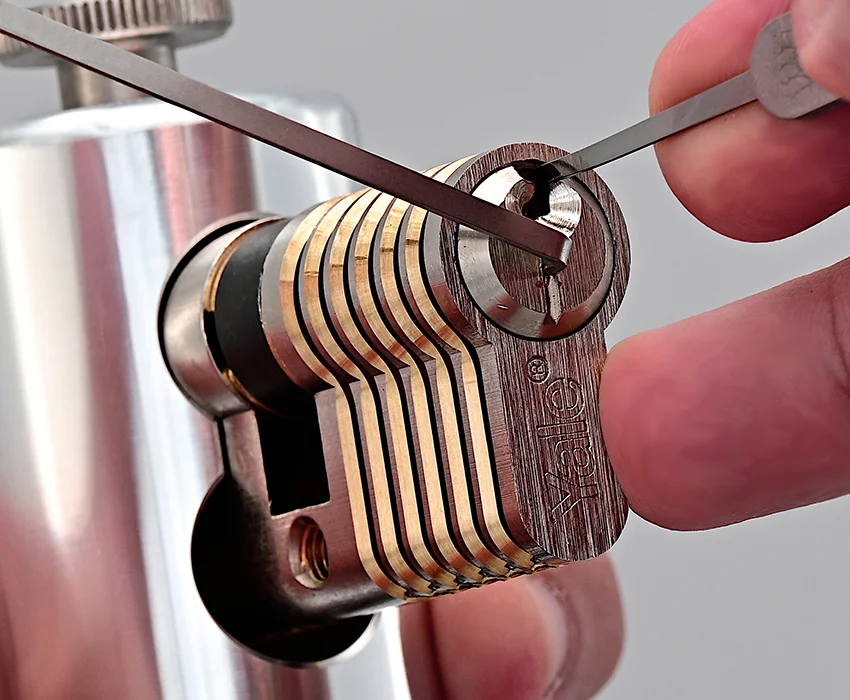
States where legal use is possible, but with additional notes
Arizona, Delaware, Kansas, Louisiana, Maryland, North Carolina, Oklahoma, South Carolina
In these states too, buying classic lockpicking tools for legal purposes is generally possible. However, there are individual additional points that customers should be aware of.
Arizona
Pick sets are generally possible for a legal purpose. However, special attention should be paid to master keys, manipulation keys or comparable specialist tools. Here, the purpose should be particularly clear.
Delaware
Here too, criminal intent is the central issue. Nevertheless, tools that are expressly suitable for unauthorised unlocking or bypassing security devices should be checked more carefully. Anyone wishing to buy, own or carry such tools should first make sure that this is permitted in their own state.
Kansas
In Kansas, the issue is less about a general ban on ownership. The context is decisive. If such tools are found during an arrest in connection with an alleged offence, additional measures such as fingerprinting may become relevant. For normal customers with a legal purpose, this is usually not a practical problem. Even so, ownership gives a very different impression when it can be clearly explained than when it appears in a suspicious context.
Louisiana
Lockpicking tools become legally relevant above all when they are connected with illegal carrying or burglary tools. Someone who trains legally, works professionally or practises locksport has a different context from someone carrying tools in a suspicious situation.
Maryland
Particular care should be taken here as soon as a tool is intended or suitable for opening vehicles. Classic picks for training, locksport or professional lock technology are assessed differently from tools whose purpose is expressly the unauthorised opening of vehicles.
North Carolina
In North Carolina, the issue is less about the mere possession of classic lockpicking tools. It becomes important when someone works with them commercially and offers paid locksmith services. Licence requirements may then apply. Anyone using the tools only for a hobby, training or locksport should clearly separate this private purpose from a professional service.
Oklahoma
In Oklahoma, possession of certain tools may be assessed particularly critically if there are previous convictions for burglary or similar offences. The combination of several tools can also play a role if they are found in a suspicious context. For normal customers without such a background, the key point remains that the purpose is clearly legal and understandable, for example hobby use, training, locksport or professional use.
South Carolina
Classic lockpicking tools are possible for a legal purpose. Separate attention should be paid to master keys, non-owner key sets and comparable specialist tools. Recommendation for these states: normal pick sets are generally orderable for legal purposes. With specialist tools, the professional, sporting or technical purpose should be clearly explainable.
States where customers should take a particularly close look
California, Illinois, Mississippi, Nevada, Ohio, Virginia
These states are not automatically problematic or “prohibited”. That is important. Here too, classic lockpicking tools can be ordered, owned and used for legal purposes, for example for training, locksport or professional lock technology. However, the rules are stricter there. Depending on the state, individual tools may be looked at more closely, especially if they cannot be clearly assigned to a legal purpose or if they appear in a suspicious context. Ownership is therefore not generally prohibited, but under certain circumstances it may require a clearer explanation. Anyone ordering from one of these states should document a little more carefully which tools they are buying and for which legal purpose they will be used.
California
California does not ban classic lockpicking tools outright. Anyone buying a pick set for locksport, training, education or professional use can generally do so. What matters is that there is no criminal intent and that the tools are used only on your own locks or with express permission. However, particular attention applies to certain tools. These include, among others, lock picks, tension bars, lock pick guns, tubular lock picks and certain specialist tools. When selling such tools to California, we as a supplier may be required to document additional customer data. For this reason, further information or proof may be requested during the purchase process. This is part of a clean, legally compliant sales process and helps to make legal buyers and legal purposes clearly traceable.
Recommendation for California: Normal pick sets can be ordered for legal purposes. Specialist tools should only be purchased with a clearly understandable justification. Invoice and order confirmation should definitely be kept.
Illinois
Illinois does not ban classic lockpicking tools outright. A pick set for locksport, training, education or professional purposes is generally possible, provided there is no criminal intent. Particular caution applies to bump keys and certain specialised tools. The sale or transfer of such tools may also be regulated more sensitively.
Recommendation for Illinois: Normal pick sets can be ordered for legal purposes. Bump keys and specialist tools should only be ordered if the purpose is clear and legally understandable. Keep the invoice.
Mississippi
Mississippi also does not ban classic lockpicking tools outright. Anyone buying a pick set for training, locksport, education or professional purposes can generally do so. However, particular caution applies to concealed carrying. If tools are carried secretly and the situation appears suspicious, this may be interpreted as an indication of possible criminal intent.
Recommendation for Mississippi: Normal pick sets can be ordered for legal purposes. Tools should not be carried concealed or without an understandable reason. Keep the invoice, order confirmation and ideally training materials.
Nevada
Nevada is one of the states where context is particularly important. Classic lockpicking tools are not banned outright, but the legal purpose should remain clearly understandable. Anyone carrying tools without a professional, sporting or otherwise plausible reason may have to explain themselves more quickly. This mainly concerns situations in which the tools appear outside a clear training, work or workshop context.
Recommendation for Nevada: Normal pick sets can be ordered for legal purposes. Keep the invoice and transport tools only with an understandable reason, for example for training, locksport, education or professional assignments.
Ohio
Ohio does not ban classic lockpicking tools outright. What matters is that they are not owned or used with criminal intent. More care should be taken with tools that may appear specially adapted, unusually combined or clearly designed for illegal use. The more specialised the tool, the more important a clear explanation becomes.
Recommendation for Ohio: Normal pick sets can be ordered for legal purposes. Specialist tools should only be purchased if the legal purpose can be well explained. Keep the invoice and order confirmation.
Virginia
Virginia is one of the stricter states. Classic lockpicking tools are not automatically prohibited, but ownership may be assessed more critically than in many other states, especially if no clear legal purpose is recognisable. It becomes problematic if tools are owned with the intention of committing burglary, theft or another offence. In addition, possession of such tools may, under certain circumstances, already be interpreted as an indication of possible criminal intent, especially for people without a suitable professional background.
Recommendation for Virginia: Normal pick sets should only be ordered for clearly legal purposes, such as locksport, training, education or professional use. Invoice and order confirmation should definitely be kept. Practice locks, locksport evidence or a professional connection help to make the legal purpose visible. Specialist tools should only be ordered if the justification can be clearly explained.
Which tools are usually less problematic in the USA?
For legal users, classic tools in particular are easy to classify in many states:
• Hook picks
• Rakes
• Tension tools and tensioners
• Pick sets for sport, education and professional work
• Practice locks, cutaway locks and training cylinders
• Spare parts, cases, handles and accessories
• Specialist literature and training materials
These tools clearly fit locksport, training, education and professional use. In the right context, they almost explain themselves.
Which tools should be checked more carefully?
More attention should be paid to tools that appear more specialised or may be expressly mentioned in individual states:
• Bump keys
• Lock pick guns and electric pick guns
• Tubular picks
• Vehicle opening tools
• Key programming devices
• Signal extenders
• Master keys and non-owner key sets
• Destructive opening tools
These tools are not automatically prohibited everywhere either. However, they require more explanation. Anyone ordering such products should know exactly why they need them and be able to prove the legal purpose.
Ordering, shipping and import: ownership rights are not the same as shipping rights
One point is particularly important: the legal situation regarding possession of a tool in your own state is not automatically the same as shipping law, import rules or customs clearance. For international shipments, customs, import duties, shipping method and recipient status may play a role. US federal law also contains its own provisions on so-called locksmithing devices in shipping. This does not mean that US customers are never allowed to own lockpicking tools. It simply means that shipping and recipient status are a separate compliance area.
For customers, in practical terms, this means: provide correct details, order seriously, keep the invoice and, if necessary, be able to make your own legal use understandable.
What US customers should keep in mind when buying from Multipick
• Anyone ordering from Multipick can create a great deal of clarity with a few simple points.
• Order using correct details. A serious order also appears serious.
• Keep the invoice and order confirmation.
• Use practice locks. A pick set together with a training cylinder immediately makes it clear that this is about training, technique and learning.
• Document professional or sporting use. A locksmith licence, a company connection, locksport evidence, training documents or security training can help make the legal purpose visible.
• Check specialist tools separately. Especially with bump keys, vehicle tools, electric pick guns, key programming devices and destructive opening systems, the purpose should be clear.
Is it a problem for Americans to buy from Multipick? – No, it is not.
Anyone who orders, owns and uses lockpicking tools for legal purposes is not moving in a prohibited area in most US states. This applies especially to locksmiths, security professionals, public authorities, technicians, property managers, locksport enthusiasts and responsible hobby users. And that is exactly why we want to provide this information as openly as possible. Our American customers should not have to guess, stumble through contradictory forum posts or feel as though they are standing alone in a legal fog. We want to give guidance, clearly and without scaremongering. The USA is more varied on this subject than you might initially think. Some differences between the states are considerable, others seem almost absurdly small. But precisely these details matter. Anyone who knows them can make better decisions, order with more peace of mind and handle the tools more responsibly. We want to make it as easy as possible for our customers to buy high-quality professional tools legally, consciously and with a good feeling.
Opening technology and responsible use
We have been dealing with professional opening tools, low-damage techniques, locksport, locksmith supplies and security-related education for many years. If you have questions about ordering, shipping or product selection, our customer service team can be contacted directly. In the event of legal uncertainty, especially regarding regulations in individual US states, an attorney licensed locally or the responsible authority should also be consulted.
The information in this article is accurate as of May 2026. It has been compiled with care, but does not replace legal advice. The author and Multipick accept no liability for the completeness, timeliness or accuracy of the information, either at the time of publication or for future developments.

FAQ – everything you need to know
1. Can US customers order lockpicking tools from Multipick?
Yes, in many cases US customers may order lockpicking tools for legal purposes. However, what matters is not only the tool itself, but also the purpose, the context and the relevant state. A pick set for locksport, education, locksmith work, security research or training on your own locks is assessed differently from the same tool in a suspicious situation in front of someone else’s property. This is exactly the key point: tools are not automatically problematic, but the wrong use certainly can be.
2. Is owning lockpicking tools generally prohibited in the USA?
No, there is no blanket ban in the USA. In most states, owning classic lockpicking tools for legal purposes is generally possible. Nevertheless, the rules differ significantly from state to state. Some states are very straightforward, while others take a closer look at certain tools. That is why it is important not to treat the “USA” as one uniform legal area.
3. Which US states are considered particularly straightforward when buying classic pick sets?
Arkansas, Indiana, North Dakota, Pennsylvania and West Virginia are considered particularly easy to classify. For these states, we are not aware of any specific lockpick rules that particularly restrict the mere possession of classic lockpicking tools for legal purposes. Customers can usually order normal pick sets for locksport, training, education or professional purposes without any particular legal hurdle. Even so, the same rule applies here: keep the invoice, use the tools properly and check specialist tools separately if necessary.
4. In which states are pick sets generally permitted, provided there is no criminal intent?
In many states, classic pick sets are not banned outright. These include, among others, Alabama, Alaska, Colorado, Connecticut, Florida, Georgia, Hawaii, Idaho, Iowa, Kentucky, Maine, Massachusetts, Michigan, Minnesota, Missouri, Montana, Nebraska, New Hampshire, New Jersey, New Mexico, New York, Oregon, Rhode Island, South Dakota, Tennessee, Texas, Utah, Vermont, Washington, Wisconsin and Wyoming. The proper context remains important: a pick set with a training cylinder, invoice and understandable purpose gives a very different impression from a tool without explanation in a situation that raises questions.
5. Why is intent so important when owning lockpicking tools?
Because many US regulations look not only at the tool, but also at the purpose behind it. A lockpick in the training case of a locksmith, in the hands of a locksport enthusiast or next to a practice lock is an understandable tool. The same tool can become problematic if it is carried concealed or appears in connection with an alleged offence. The legal assessment therefore depends heavily on whether a legal purpose is visible.
6. Which states should US customers check particularly carefully?
Customers from California, Illinois, Mississippi, Nevada, Ohio and Virginia should take a particularly close look. These states do not automatically mean “prohibited”, but they can be more sensitive. Classic pick sets are often possible there too for legal purposes, for example for training, locksport or professional lock technology. However, specialist tools, concealed carrying or a lack of clear legal context may require a more detailed explanation more quickly. Anyone ordering from one of these states should document the invoice, order confirmation and legal purpose carefully.
7. Which tools are usually easier to classify for legal users in the USA?
Classic lockpicking tools such as hook picks, rakes, tensioners, normal pick sets, practice locks, cutaway locks, training cylinders, spare parts, cases, handles and specialist literature are usually easier to classify. These products clearly fit locksport, education, training and professional use. The legal purpose becomes particularly clear when a pick set is purchased together with practice locks or training material.
8. Which lockpicking tools should US customers be more cautious with?
Bump keys, lock pick guns, electric pick guns, tubular picks, vehicle opening tools, key programming devices, signal extenders, master keys, non-owner key sets and destructive opening tools should be checked more carefully. These tools are not automatically prohibited everywhere, but they appear more specialised and may be assessed more strictly in individual states. Anyone ordering such products should know very clearly why they need them and be able to prove the legal purpose in an understandable way.
9. Is the right to own the same as shipping or import law?
No, and this is exactly the point that is often overlooked. Just because a tool may be owned for legal purposes in your own state does not automatically mean that shipping, import, customs clearance or recipient status operate entirely without their own rules. Additional requirements may apply to international shipments. For customers, this means: provide correct details, place a serious order, keep the invoice and, if necessary, be able to explain the legal purpose of use.
10. What should US customers keep in mind when buying from Multipick?
US customers should order using correct details, keep the invoice and order confirmation and use the tools only on their own locks, training cylinders or with express permission. Anyone working professionally can keep a locksmith licence, company connection or training documents ready. Locksport enthusiasts can document training materials or club connections. With specialist tools, the purpose should be particularly clear. Multipick provides this information so that customers do not have to grope around in the fog, but can order consciously, legally and with a good feeling.
About the Author
Lars Buchwald has been an integral part of the Multipick team since 2006, where he dedicates his passion and expertise to marketing and graphics. As a trained graphic designer and copywriter, he brings a wealth of experience and creativity to his work, which enables him to convey the messages of the ingenious tools in an appealing and convincing way. With a keen sense for the needs of the target group, he steers Multipick's marketing fortunes. His commitment is characterized by a high degree of sensitivity and the right richer at the right time.
As a native of Bonn, Lars not only has close ties to the region, but has also firmly integrated his passion for marketing spear tools into his professional work. His attachment to the city is reflected in his work and gives his marketing campaigns an authentic, Bonn touch.
Related Articles
Burglary Protection Myths
That only happens to other people …
Lockpicking Across the EU
Lockpicking in the EU: Differences in National Laws – and What Really Happens
Locksmith Services – A Good Reputation Opens Doors
"You're honest, aren't you?" – A Question Loaded with Meaning
About Multipick
Multipick was established here in Bonn in 1997 and has had its headquarters and production facilities here on the Rhine ever since.
Why should we leave here? Anyone who has been here before will agree that it is a very beautiful place and that the people are ‘typically Rhineland’, open-minded and friendly. From an early stage, we began to occupy ourselves with a wide variety of entry tools. We tried out lock snappers and core extractors such as the Bell and gathered a wealth of experience with a wide variety of tools. Whether it was a lock pick set or special tools for fire brigades and locksmiths, in the end the door or window had to be opened. In line with the motto, you got the problem and we got the solution.
Many tools, irrespective of hobby or professional, are dispatched from our warehouse to destinations throughout the world.
Opening tool kits for caretakers and locksmiths, pick sets and lock picking accessories for Locksport enthusiasts and Hobbs hooks for specialists to unlock locked safes. There are thousands of different ways to deploy our specialised tools. Our TFG latch plates and key turners allow a closed door to be reopened. QA Pro 2 and our V-Pro core pulling screws can be used to open a locked door. We also offer milling burrs and drill bits for those situations where there really is no other way. Many useful aids such as MICA opening cards, wedges, door latch spatulas, door handle catches and spiral openers, which are all useful tools to help you get the job done. But even if things get a bit complicated, you are in good hands with us. Products such as the Kronos and Artemis electric picks are our top highlights. Anyone who likes to open dimple locks or disc locks will be delighted with the ARES system. For opening windows, we offer you a range of top products from Kipp-Blitz. Favoured by emergency services such as the fire brigade, THW (Federal Agency for Technical Relief) and police. Many of our tools are manufactured in-house. This gives us the liberty to manufacture quickly and in a customer-orientated manner. No lengthy supply chains and subcontractor dependencies. This has a number of advantages both for you and, of course, for our environment. One big advantage is that you get everything from a single source, enabling us to offer you consistent quality. This is also our promise to you, all from a single source, Made in Germany, Made in Bonn - promised.

